The Future of Sales: AI Systems That Run the Whole Revenue Operation
By Jake Hissitt, Founder of Stob.AI. Published 22 October 2026.
Research prospects. Find contacts. Write emails. Follow up. A growing number of businesses now hand fragments of that work to tools such as Claude, ChatGPT or Gemini. Used task by task, though, someone still has to prompt each step, move the output between tools and confirm what actually happened. The model assists; the person still operates the process.
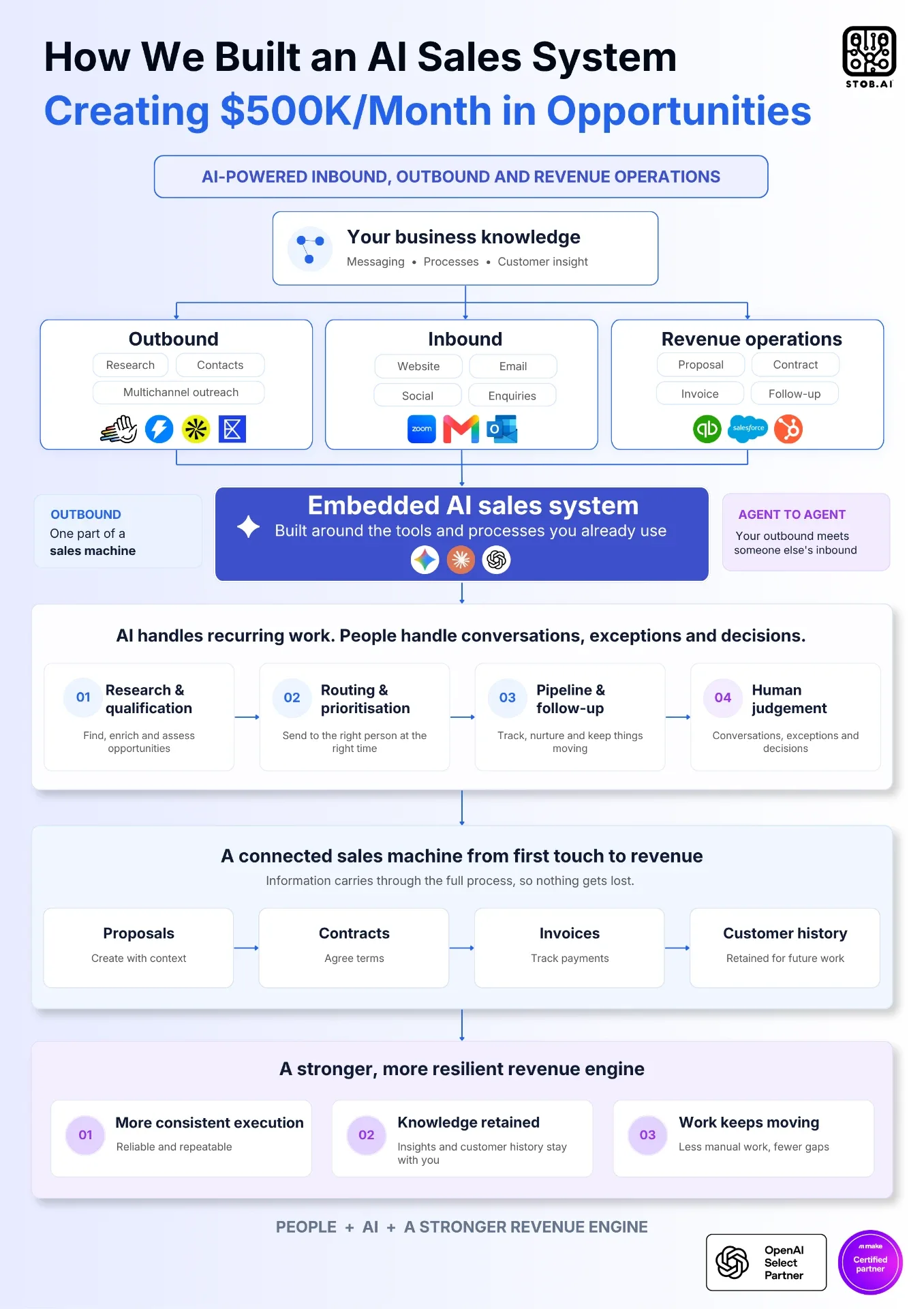
The more durable shift is a holistic system, where AI agents handle the recurring work across the entire revenue operation inside agreed rules, and people handle conversations, exceptions and commercial decisions. Here is how that shift is developing across five fronts—and what it means for how you build.
1. Outbound becomes an automated process
The recurring outbound workload is well understood:
- Research relevant prospects
- Find and enrich contacts
- Personalise outreach
- Automate follow-up
- Route interested responses to salespeople
Once that process is established, it can operate continuously within agreed rules. The tooling is already mature: prospect data from Apollo.io, web research from Exa, sending through Instantly.ai and HeyReach, all connected through orchestration platforms such as Make or n8n.
The model's job inside that system is interpretation—summarising a company, classifying a reply, drafting a message against approved messaging—not deciding who gets contacted or when. Humans focus on handling the increased pipeline and making commercial decisions. The routing moment is the critical control point: our guide to sales handoff automation covers how qualified interest should reach an accountable salesperson with full context, and the seven-layer AI sales system architecture shows how the pieces fit together.
2. Inbound and outbound become connected
Every enquiry, response and conversation contributes to the same system. What the business learns from inbound—which messages land, which segments convert, which objections recur—can improve future outbound targeting and messaging. Customer history becomes available across the entire process instead of sitting in separate inboxes and spreadsheets.
CRMs such as HubSpot, Salesforce or Attio can hold that shared history, but only if the records are maintained. Connection without hygiene produces confident automation on top of unreliable data; see CRM automation and CRM hygiene automation for how we keep the record trustworthy.
3. Revenue operations become connected
As the system develops, more processes can be joined together:
- Qualification informs proposals
- Accepted proposals trigger contracts
- Contracts connect to invoicing
- Payment terms inform follow-up
The customer's history carries through each stage, so nothing restarts from a blank page. Tools such as Salesforce, Intuit QuickBooks and Stripe can become part of the same connected process. The design principle is the same as in sales: deterministic handoffs for precise operations, model judgement where interpretation adds value, and human approval where the consequences justify it. Our guides to sales operations automation and deal reactivation automation cover two of the highest-value lanes in detail.
4. Knowledge stays within the business
One of the few moats a business has in the age of AI is its accumulated knowledge: processes, messaging, customer history and an understanding of why customers actually buy. Every lesson can inform the next campaign, qualification decision and proposal—but only if the lesson is captured in a system the business owns, rather than in someone's head or a rented black box.
Building this capability internally means the work can keep moving when someone gets sick, is late to work or leaves. It also means the system compounds: each correction and each campaign makes the next one sharper. Our Lumens business development case study shows this operating model in production, and agency vs owned system explains the trade-offs of building versus renting it.
5. AI agents begin communicating with other agents
As AI makes outbound easier to produce, the volume of messaging will increase. Businesses will increasingly use their own agents to assess the relevance of incoming approaches—which means your outbound system will increasingly be speaking to someone else's inbound system.
Interoperability standards are emerging to support this, including the Agent2Agent protocol and Anthropic's Model Context Protocol. What matters commercially is not the protocol but the substance: whether those systems understand the business well enough to recognise a relevant opportunity and know when to involve a person. That understanding comes from your customer history, your processes and everything you learn from running campaigns—not from a larger model alone.
Where this leaves sales teams
Whether you build the system yourself or bring in specialists, the knowledge should stay within your business. The sooner you start building on it, the more powerful your system becomes.
A practical starting point is one bounded lane: automate outbound research and routing with human approval, prove it against a quality standard, then connect inbound and revenue operations. If you want to see what this looks like as a managed build, our Business Development as a System page describes the operating model, and a workflow audit maps where automation would pay back first in your own process.