Sales Ops Automation: Routing, Pipeline Controls and Reliable Handoffs
Sales Ops automation turns agreed sales policies into repeatable, observable workflows for routing, pipeline administration, approvals, handoffs and reporting. It should make responsibility clearer, not merely create more activity.
At Stob.AI, we distinguish sales productivity from sales operations. Drafting an email helps a rep complete a task. Ensuring an eligible lead has the right owner, an approved next action and a visible exception path helps the whole sales organization operate reliably.
This article covers that operating layer. CRM automation focuses on records and integrations; CRM hygiene focuses on data trust. Sales Ops connects those capabilities to commercial rules, service expectations and cross-team accountability.
Start with policies your team can actually agree on
An automation cannot resolve a territory dispute by itself. Before building routing, decide which rule takes precedence: existing account ownership, territory, product expertise, strategic account status or workload. Define a fallback owner and how exceptions are resolved.
The same applies to stages. “Proposal sent” should have a consistent meaning and evidence standard. A model seeing enthusiastic language in an email does not authorize it to move a deal into a forecast category. Separate suggested interpretation from the owner's commercial judgment.
Sales Ops normally focuses on the sales motion. RevOps extends governance across marketing, sales, customer success and revenue processes. A workflow can span both, but choose a named accountable owner rather than relying on a category label.
Six useful Sales Ops automation candidates
| Candidate | Accepted outcome | Approval/control |
|---|---|---|
| Lead routing | Current eligible lead assigned and accepted | Ownership precedence and fallback queue |
| Follow-up escalation | Overdue work reaches an accountable backup | Business-hour deadlines and absence policy |
| Pipeline review | Owner reviews missing evidence or inconsistent stage | Do not auto-invent commercial progress |
| Deal-desk intake | Complete request reaches the correct approver | Versioned terms, pricing and authority limits |
| Closed-won handoff | Delivery accepts verified scope and project record | Sales and delivery sign-off |
| Reporting reconciliation | Report uses agreed definitions and verified source data | Exceptions visible, not silently filled by AI |
Compensation and territory changes can be valuable candidates, but they are consequential. They require specialist policy review, controlled access and robust reconciliation. Do not make them the first pilot simply because the underlying calculation looks repetitive.
Use an operating contract for every workflow
Define trigger, eligibility, authoritative record, permitted actions, accountable role, deadline, acceptance evidence and failure path. Include a version for the policy and approval. That makes a later investigation answerable: which rules applied when the action took place?
A practical work record includes the source object ID, event identity, current state, policy version, approver, external action IDs and unresolved reason. Distinguish “request accepted,” “record written,” “receiving team accepted” and “completed.” These events need not happen at the same time.
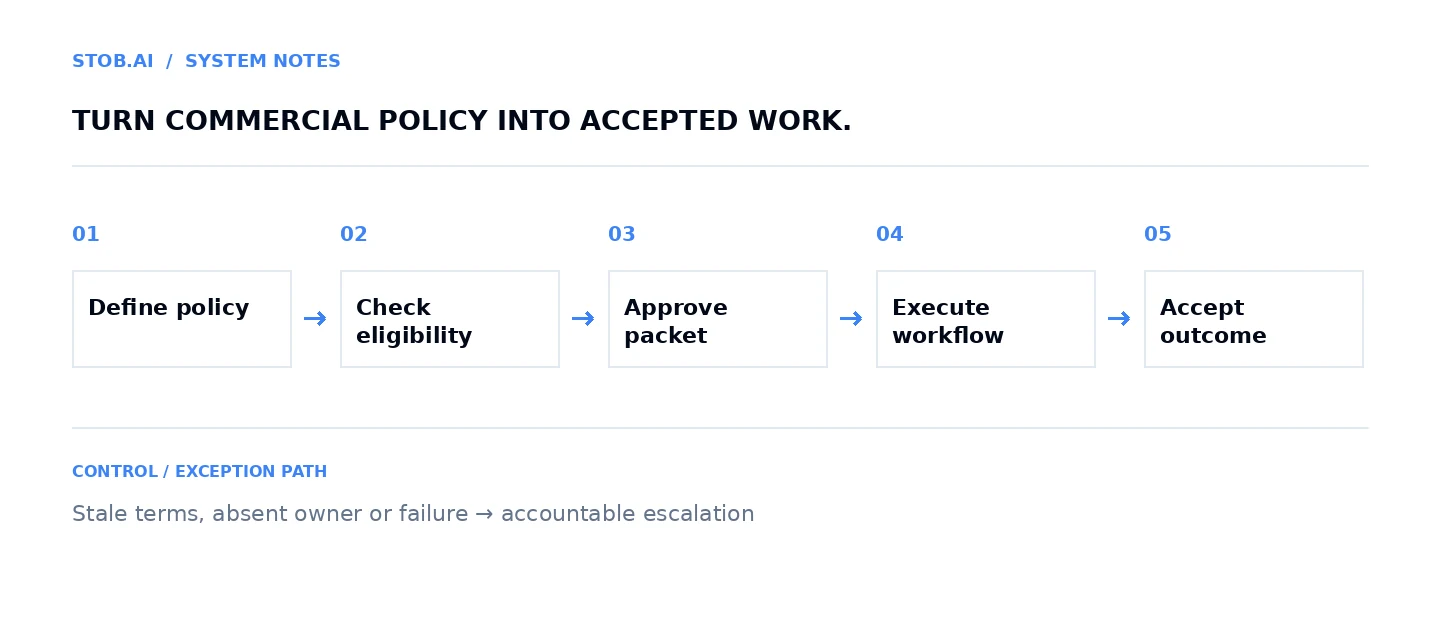
Example: closed-won to an accepted delivery project
Validate the transition
Receive the deal event or poll the CRM, then retrieve the current record. Confirm it satisfies the organization's closed-won definition and that required agreements and scope evidence exist. A stale event should not override a later change.
Prepare the delivery packet
Retrieve approved commercial documents and relevant notes. Claude or OpenAI can draft a structured scope summary with evidence links and missing-information flags. The model should not infer delivery dates, warranties or exclusions from a salesperson's optimistic wording.
Sales Ops checks the packet and delivery confirms responsibility. If the scope is incomplete, return it with a reason. The automation should make that interruption clear; it should not create a project merely to preserve its success rate.
Execute only the approved version
Make creates the downstream project through the tool's supported integration, stores its ID and writes the reference to the CRM. Use an operation key based on deal ID and handoff version. If project creation times out, search or reconcile using that identity before creating again.
Re-read the project and CRM reference. Mark complete only after the receiving team has accepted and the required records are verified. A later scope change should create a new approval version rather than silently mutating an already accepted packet.
Pipeline controls should surface uncertainty, not hide it
Useful controls identify stale next actions, missing decision makers, inconsistent close dates and deals without the evidence expected at their stage. They should route a review task to the owner and preserve the reason.
Define meaningful buyer activity separately from CRM modification. An integration updating a field is not buyer engagement. The deal reactivation playbook explains how to detect inactivity without confusing system events with renewed interest.
Keep forecast recommendations and recorded commitments distinct. A model can summarize risks from notes, but forecasting accountability remains with the commercial owner. If a report uses AI-generated commentary, link it to the underlying figures and disclose uncertainty.
Build recovery into the operating routine
Make's scenario settings support ordered processing, but an unresolved incomplete run can delay following work. Ordering trades concurrency for a different operational risk; it is not a universal setting to enable without thinking.
Incomplete-execution settings determine how failed work is stored and what happens when storage cannot accept more items. Do not permit silent loss of consequential work to keep the schedule running.
Make also documents that retried incomplete executions retain the module settings from the error. A repaired current scenario does not necessarily make a stored historical retry safe. A responder needs to inspect the affected operation and current external state.
Assign an incident owner, severity, response expectation and fallback process. Salespeople should know where to see unresolved work and how to pause affected activity. A technical alert sent to an unattended mailbox is not an operating model.
Separate business and technical ownership
| Responsibility | Accountable role | Evidence |
|---|---|---|
| Qualification and routing policy | Commercial/Sales Ops owner | Versioned definitions and precedence rules |
| Access and integration reliability | Technical owner | Permissions, monitored runs and recovery procedure |
| Scope and pricing decisions | Authorized commercial approver | Approved packet tied to current terms |
| Receiving work | Sales or delivery recipient | Accepted responsibility or reasoned return |
| Quality improvement | Service owner | Weekly review of defects and policy changes |
One person may hold several roles in a small team. The point is not to create bureaucracy but to prevent “the automation owns it” from becoming a substitute for accountability.
Measure the outcomes using fixed cohorts
- On-time acceptance: eligible work accepted and verified by deadline divided by all eligible work due in the period.
- First-pass quality: packets accepted without correction divided by packets first submitted.
- Exception rate: unique items requiring manual exception handling divided by unique eligible items.
- Cost per accepted outcome: allocated platform/model spend plus review, repair and maintenance labor divided by verified accepted outcomes.
- Latency: median and p90 for completed work, reported alongside overdue unresolved count and age.
Do not compare a new automated cohort with a historically easier manual cohort. Keep scope, eligibility and observation windows consistent, and disclose changes in volume. Released capacity, pipeline value and collected revenue are different measures.
A practical rollout sequence
Map one workflow, agree the accepted result and test a representative set before writing live records. Run the first cohort with visible review, then reduce approval burden only for stable, reversible actions under an agreed policy. Maintain human decisions for uncertain or consequential work.
Review rejection reasons weekly. A rising exception queue can indicate missing data, an unclear rule or a broken integration. Fix the source before adding more channels or increasing volume.
Stob.AI's view
Our Lumens implementation connects prospecting, outreach, ownership context, CRM continuity and reporting. It illustrates why an operating layer matters: the individual tools can remain, while the work between them becomes explicit.
Sales Ops automation is worthwhile when it makes the process easier to run and inspect. For the component decisions, read sales handoff automation, AI sales agents and agency versus owned system.
Frequently asked questions
What is Sales Ops automation?
It implements agreed sales policies through workflows for routing, pipeline controls, approvals, handoffs and reporting, with explicit ownership and verifiable results.
How is Sales Ops automation different from CRM automation?
CRM automation centers on records and integrations. Sales Ops automation connects those changes to commercial policies, team responsibilities, deadlines and accepted outcomes.
Should an AI model update opportunity stages automatically?
Not from inferred enthusiasm alone. Stage changes need agreed evidence and authorized policy; ambiguous or material changes should go to the accountable owner.
What is the best first Sales Ops automation?
A frequent, bounded process such as approved routing or a delivery handoff, where eligibility, record identity, acceptance and exception ownership are clear.