Agency vs Owned System: Compare Control, Operation and Exit
An agency provides delivery and operating capacity. An owned system gives the client agreed control over accounts, data and bespoke assets. These choices can coexist: an agency can build and operate a client-controlled system, then transfer operation when the team is ready.
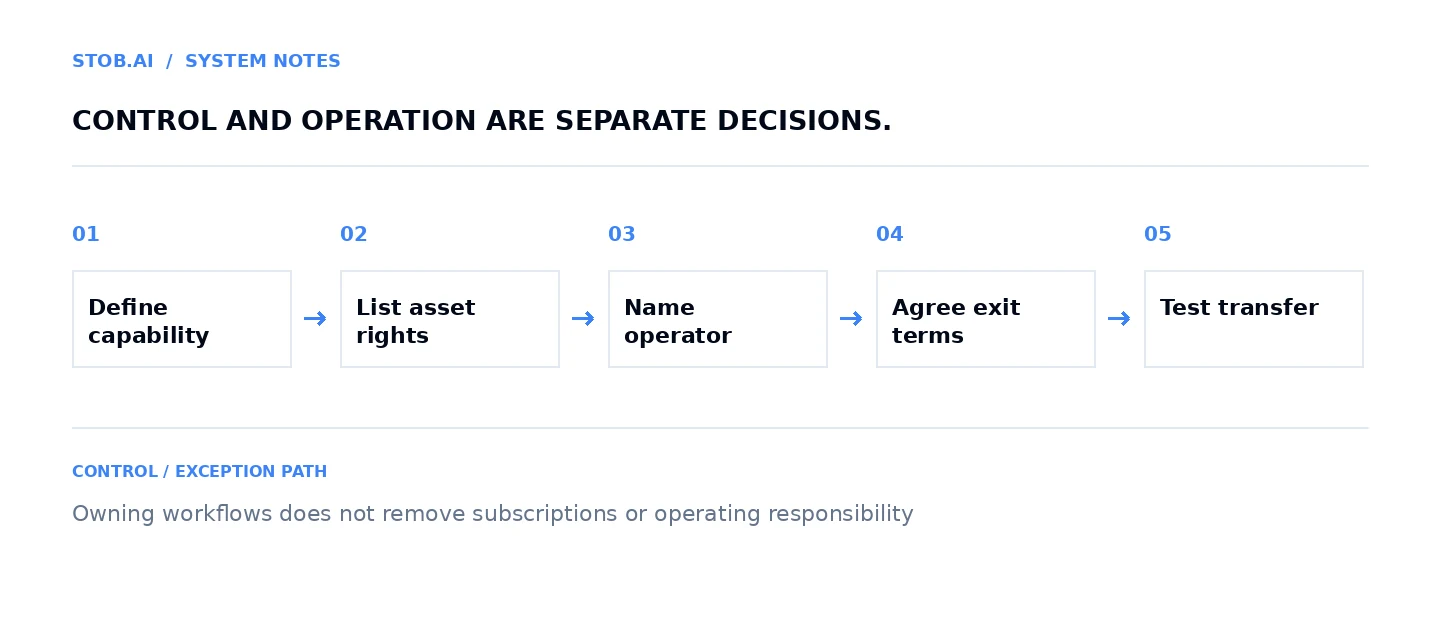
At Stob.AI, we think “agency versus ownership” is often the wrong binary. Buyers need to decide what capability they want, what they should control and who will perform the recurring work. Owning a workflow does not make it self-maintaining, and paying a retainer does not necessarily mean surrendering control.
This guide focuses on sales and operational systems, not media-buying or creative-service procurement. Its purpose is to make proposals comparable and termination survivable. For the separate software decision, read automation versus SaaS.
Separate the capability from the operator
A working sales system includes targeting rules, research, messaging, reply handling, CRM continuity, exceptions and reporting. Some of that work is software; some is ongoing judgment. A build-only project may deliver the workflow without delivering campaign strategy or staffed response coverage.
If a managed provider supplies strategy, copy, optimization and monitoring, compare it with an alternative that includes those responsibilities. Comparing its retainer with a setup fee alone is not a fair economic test.
Four arrangements buyers should understand
| Arrangement | Control | Operation | Main trade-off |
|---|---|---|---|
| Managed service | Defined by contract | Provider | Less internal burden; continuity depends on agreed access and exit |
| Build and hand over | Client rights subject to agreement and licenses | Client | Control requires capable internal operation |
| Build plus managed operation | Client-controlled accounts and agreed assets | Provider | Ongoing help without necessarily surrendering control |
| Build, operate, transfer | Defined at each contract stage | Provider, then client or successor | Transition needs tests, time and funding |
No arrangement is inherently superior. A short campaign may not justify permanent internal capability. A strategic process may justify stronger client control even when the agency continues to operate it.
Define ownership asset by asset
“You own the outputs” is insufficient. It might mean you can use finished messages without granting access to workflow accounts, source code or operating documentation. List the assets and rights explicitly.
- Accounts: organization administrators, billing, recovery contacts and revocation rights.
- Business data: records, sources, history, customer restrictions and usable exports.
- Bespoke deliverables: code, mappings, schemas, prompts, dashboards, rules and documentation.
- Reusable provider components: licenses, modification rights and successor access.
- Third-party services: vendor terms, software licenses and dependencies the client does not own.
- Practical control: the ability to modify, run, inspect and recover the system without an undocumented dependency.
Make, CRM software and model APIs remain vendor infrastructure. A provider cannot assign intellectual property it does not own. Ask a qualified adviser to review legal terms; this is operational buying guidance, not legal advice.
Name the recurring responsibilities
| Responsibility | Question to resolve |
|---|---|
| Daily monitoring | Who checks failed work and within what service hours? |
| Business rules | Who approves targeting, qualification and follow-up changes? |
| AI quality | Who tests classification and drafts after model or prompt changes? |
| Recovery | Who reconciles partial success before retrying? |
| Access | Who renews connections, rotates credentials and removes departed users? |
| Data governance | Who handles retention, suppression and privacy requests? |
| Commercial action | Who approves commitments and accepts sales handoffs? |
| Continuity | Who can operate the system if the primary operator leaves? |
Keep one accountable service owner even when duties are shared. Avoid “client handles the business, agency handles technology” as the whole responsibility map: a failed reply classification can involve both.
A worked 36-month operating-cost comparison
Illustrative USD assumptions, not Stob.AI prices or market benchmarks. Both options are assumed to cover the same workflow and required service coverage. Tooling is shown separately.
| Cost | Managed agency | Build and hand over |
|---|---|---|
| Initial implementation | $5,000 | $18,000 |
| Monthly management/support | $1,800 | $300 |
| Monthly tooling/API costs | $300 | $300 |
| Monthly internal ownership | 4 hours × $60 = $240 | 20 hours × $60 = $1,200 |
| Exit/transfer allowance | $3,000 | $2,000 |
| 36-month total | $92,240 | $84,800 |
Managed total: $5,000 + 36 × ($1,800 + $300 + $240) + $3,000. Handover total: $18,000 + 36 × ($300 + $300 + $1,200) + $2,000.
Handover is $7,440 lower under these assumptions, but uses much more internal time. If client operation needs 30 hours per month rather than 20, its total becomes $106,400. Ownership is not automatically the cheaper operating model.
Normalize scope before using these calculations. Strategy, creative production, response coverage and continuous improvement must either be included in both options or separately valued. Released capacity is not automatically cash savings.
Test whether control survives termination
Ask a successor operator to run a representative workflow using the handover pack. Can they locate the source of truth, reconnect accounts, understand approvals, inspect an exception and recover from a failed write?
Make supports scenario blueprint exports, but connections must be recreated after import. An export can be valuable without being a complete operational handover. Include dependencies, mappings, test records, known limitations and recovery instructions.
Transfer credentials securely and rotate them. Do not place active secrets in a general handover document. Confirm access, billing, administrators and recovery contacts before the old provider loses access.
Agree notice periods, transfer hours, fees, assistance, data deletion and continuing access windows. Test reconstruction before cancellation; a termination clause cannot replace a usable recovery procedure.
When managed operation is the better choice
Choose managed operation when the team lacks an operator, the workload changes frequently, response coverage exceeds internal capacity or ongoing optimization is a material part of the value. A credible provider should still offer measurable service boundaries and inspectable evidence.
Provider dependence can be an acceptable conscious choice. The problem is hidden dependence: workflows tied to a personal account, no export rights, unrecorded business rules or access ending before a successor can take over.
A sensible hybrid transfer path
- Agree the business outcome, assets and operating responsibilities.
- Use client-controlled organizational accounts where practical.
- Build and test one complete workflow with failure cases.
- Operate with the provider while the client observes real exceptions.
- Have the client shadow daily monitoring and recovery.
- Transfer only after the receiving operator demonstrates competence.
- Retain optional support with explicit scope and service expectations.
Do not make handover contingent solely on a calendar date. The receiving team should prove it can pause activity, handle opt-outs, reconcile partial success and update a rule safely.
What public Stob.AI evidence does—and does not—show
The Lumens AV case study shows connected business-development infrastructure using an operating layer alongside the CRM, with people retaining commercial decisions. It is evidence of an implemented pattern, not a published contract guaranteeing the same ownership terms or economics for every engagement.
At Stob.AI, we recommend deciding the ownership schedule and operating model before comparing headline fees. The target is a system that remains useful, understandable and controllable whether we operate it, your team operates it or another partner takes over.
Continue with Sales Ops automation for the responsibility map and our modular sales-system guide for the underlying architecture.
Frequently asked questions
Is an owned system the opposite of an agency service?
No. An agency can build and operate client-controlled infrastructure. Asset control and recurring operation are separate decisions.
What should a client own or control?
Specify organizational accounts, business data, bespoke deliverables, documentation and practical operating access, while distinguishing reusable provider IP and third-party licenses.
Does an owned system still need support?
Yes. Monitoring, exception recovery, connection renewal, security, business-rule changes and AI evaluation remain operating responsibilities.
How can a buyer verify a handover?
Have a receiving operator reconstruct connections, run a representative workflow, inspect failures and recover safely using the actual handover pack before ending the old service.