Sales Handoff Automation: From Interested Lead to Accountable Owner
Sales handoff automation transfers a sales event, its supporting context and responsibility for the next action to a named person or team. It is complete when the receiving owner accepts the work and the required records are verified—not when a notification is sent.
At Stob.AI, we treat the handoff as an operating process rather than a CRM integration. The salesperson should receive the original conversation, the reason the prospect is relevant, the promised next step and a clear deadline. The system should know whether those requirements were met and what remains unresolved.
This guide covers lead-to-sales, SDR-to-account-executive and sales-to-delivery handoffs. If your narrower problem is moving outreach replies into the CRM, start with our CRM handoff automation guide. Here we focus on the wider transfer of responsibility across people and tools.
Why handoffs fail even when the tools are connected
A positive reply can exist in an inbox while the CRM says the prospect is still in a sequence. A booking can appear in a calendar without an account owner. A closed-won deal can trigger a project without anyone confirming that the agreed scope is ready for delivery.
These are three different defects: lost context, unresolved ownership and premature completion. Adding another alert may make them more visible without fixing any of them. A reliable handoff needs an explicit contract between the sending and receiving teams.
| Handoff | Minimum useful packet | Completion evidence |
|---|---|---|
| Inbound enquiry → sales | Contact, request, source, eligibility and accountable owner | Owner accepts; next task is visible in the CRM |
| SDR → account executive | Conversation, qualification evidence, objections, commitments and meeting context | AE accepts or returns a reason for rejection |
| Sales → delivery | Approved scope, commercial terms, dependencies and customer commitments | Delivery accepts; project and CRM references are verified |
Define the handoff contract before choosing software
Write down the trigger, required information, owner-selection policy, acceptance standard and exception route. Avoid defining a qualified lead solely through a model score. State what evidence the next team needs: a relevant account, an identifiable contact, a stated problem and a next action they have agreed to take.
The receiving team must be able to decline with a reason such as duplicate opportunity, wrong territory, missing context or no commercial fit. Rejections are useful operating feedback. If they disappear into Slack, the originating workflow will keep making the same mistakes.
Separate assignment from acceptance. Assignment means the workflow selected someone. Acceptance means that person or team has taken responsibility. A salesperson opening a notification is not necessarily acceptance, and a calendar booking is not proof of a qualified opportunity.
Set deadlines that match your service hours and capacity. Record the business timezone, holidays, unavailable owners and fallback queue. An example target such as acceptance within two business hours is a planning choice, not a universal standard or a Stob.AI service promise.
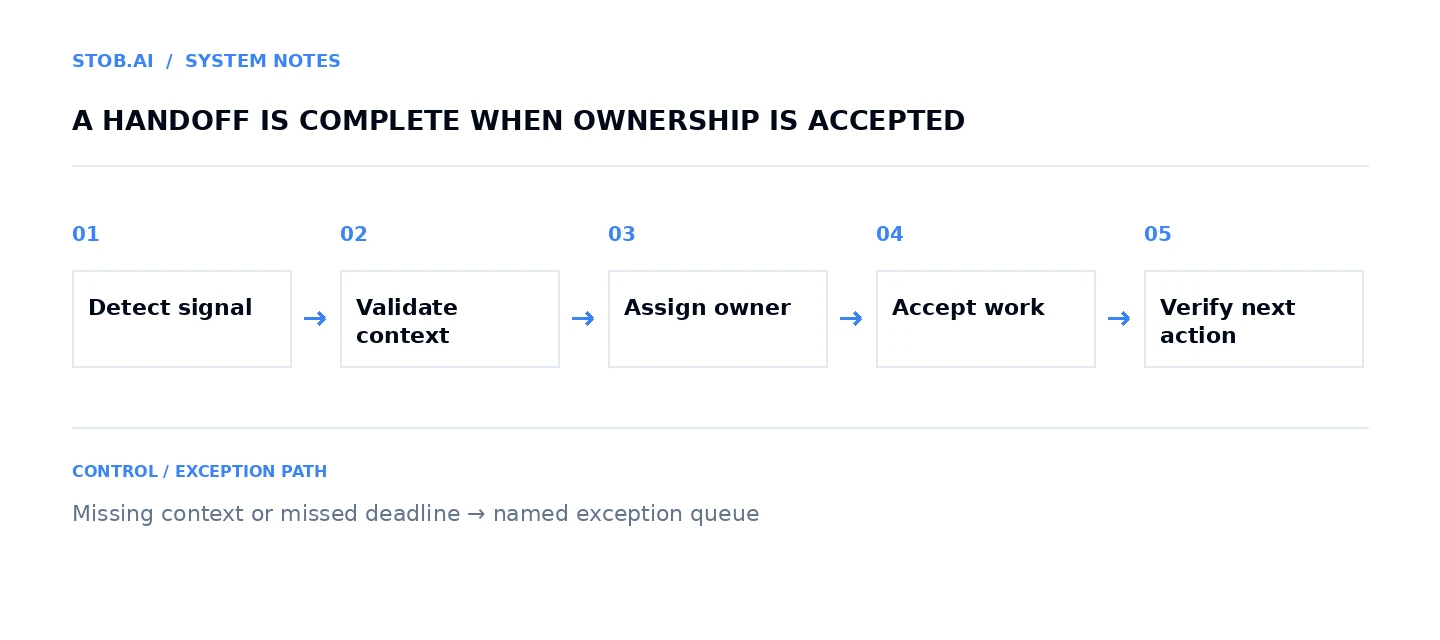
A practical positive-reply handoff workflow
1. Capture the event without losing the conversation
Store the original reply identifier, thread reference, timestamp, sender account and campaign context. Detect duplicate delivery with a stable source event key. Do not use the contact's email as the event key: one contact can send several legitimate replies.
Stop or pause the relevant outbound follow-up through the sending tool's supported controls. Verify that change. Otherwise the system can route an interested reply to sales while the prospect receives another automated nudge.
2. Resolve identity and existing ownership
Find the CRM contact, company and open opportunities through stored identifiers or an approved matching policy. Preserve existing account ownership unless a documented rule says otherwise. If two accounts plausibly match, route to review instead of creating a third.
CRM objects, records, properties and associations are distinct concepts; HubSpot's CRM documentation explains those boundaries. A contact record alone does not prove that the company and deal relationships are correct.
3. Interpret intent, then validate it
Use Claude or OpenAI to propose an allowlisted category such as interested, referral, timing request, objection, opt-out or unknown. Include the source text supporting the classification. A reply saying “send details, but do not call me” contains both interest and a channel restriction; do not compress it into a generic positive label.
Handle clear opt-outs through suppression rules. Ambiguous commercial intent should go to a person. AI is useful for reducing reading effort, not for inventing consent or qualification evidence.
4. Assemble the packet and request acceptance
Create a concise summary with links to the original thread and relevant account record. Include what was promised, what remains unknown and the recommended next action. The receiving owner should not have to search five applications to reconstruct the conversation.
Write the handoff state into a work record, notify the owner in their existing tool and expose an accept/return decision. When the owner accepts, create or confirm the next task and read it back. Rejected packets return to a named queue with a reason.
5. Escalate unresolved work
If the deadline expires, escalate to a backup rather than silently selecting a new owner. Log who changed ownership and why. If the CRM is unavailable, preserve the packet and pause dependent actions; do not report success because the notification worked.
The failure cases your pilot should include
| Test case | Expected behavior |
|---|---|
| The same reply arrives twice | One handoff for that event; no duplicate task or message |
| A CRM write succeeds but its response times out | Reconcile the destination before creating again |
| Account ownership changes during approval | Re-read the current record and invalidate stale assignment |
| The assigned owner is absent | Use the documented backup queue and deadline |
| The customer opts out after the draft is approved | Current suppression state blocks execution |
| The packet lacks delivery scope | Return for correction; no completed handoff claim |
AWS's guidance on safe retries explains why repeated requests need explicit identity and reconciliation. A search-before-create check alone does not prevent two concurrent runs from both creating a record.
Make can process webhook runs in parallel; scenario settings allow ordered processing. Choose the concurrency policy deliberately. Ordering can reduce races within that scenario, but it does not lock unrelated systems or other writers.
Measure the transfer, not the alerts
- On-time accepted handoffs: handoffs accepted and verified by deadline divided by all eligible handoffs due in that period. Include unresolved and failed items in the denominator.
- First-pass acceptance: packets accepted without correction divided by packets first submitted in the same cohort.
- Context completeness: required information present divided by applicable required information across assessed packets.
- Latency: median and p90 trigger-to-acceptance time for completed items, alongside the count and age of unresolved items.
- Commercial progression: accepted handoffs that become sales-accepted opportunities under your written definition. Keep this separate from bookings and replies.
A fast median can hide a small number of permanently stuck prospects. Review the oldest unresolved packet and the rejection reasons weekly, not just average speed.
What Stob.AI's implementation perspective adds
Our Lumens AV case study describes an Airtable operating layer connected to Zoho, with source, campaign, ownership and next-action context. The relevant lesson is that the CRM can remain the formal commercial record while the operating layer coordinates work around it. It is not evidence that an alert alone generates revenue.
We start with one complete handoff, use Make for controlled execution and AI for bounded interpretation, then test failures with the people who will receive the work. Expanding channel volume before that receiving process works usually expands the backlog.
Continue with CRM automation for field and integration design, Sales Ops automation for cross-team policy, and the deal reactivation playbook for returning dormant opportunities to an owner.
Frequently asked questions
What is sales handoff automation?
It transfers a sales event, its evidence and responsibility for the next action to a named owner. Completion requires acceptance and verified records, not just a sent notification.
How is a handoff different from lead routing?
Routing selects an owner. A handoff also transfers context, commitments, deadlines and an acceptance decision, then verifies the required next action.
Can AI decide whether a lead is qualified?
AI can summarize evidence and propose a classification. Qualification policy, required evidence and consequential decisions should remain explicit and subject to human review when uncertain.
What should a sales handoff SLA measure?
Measure the share of eligible handoffs accepted and verified by deadline, including overdue failures and unresolved items in the denominator.