Deal Reactivation Automation: An Open Implementation Playbook
Deal reactivation automation identifies eligible dormant opportunities, prepares a relevant follow-up and returns genuine renewed interest to an accountable salesperson. It should not repeatedly enroll every old contact or mistake CRM edits for buyer engagement.
At Stob.AI, we treat reactivation as a separate operating lane from new prospecting. The existing relationship can provide useful context, but it also brings old promises, unresolved objections, changed contacts and communication restrictions.
This is an open implementation playbook. The fields, rules, message patterns, test cases and checklist are included below without a download or email gate. The example thresholds are starting design assumptions, not industry benchmarks or guarantees.
Separate stalled-open deals from closed-lost opportunities
A stalled open deal may still be in procurement, awaiting an agreed date or owned by a salesperson who has not updated the CRM. A closed-lost opportunity has an explicit past decision. Reactivating them as one cohort obscures the reason to contact the buyer.
| Cohort | Useful reason to review | Do not assume |
|---|---|---|
| Open, no meaningful activity | Owner confirms the next action is missing or stale | Old activity date means the buyer abandoned the process |
| Closed-lost: timing | An agreed review date arrives | Timing has changed without evidence |
| Closed-lost: budget or fit | A verified relevant change or owner-led review | Generic urgency solves the original objection |
| Departed champion | Research and owner review establish a suitable relationship path | The old contact details or permission still apply |
| Unknown stall reason | Internal record review | AI should invent a reason to personalize outreach |
Our Lumens case study describes reactivation cohorts with source and campaign context alongside new acquisition. It supports the architecture of a separate coordinated lane; it does not establish a universal inactivity threshold or causal uplift.
Define meaningful buyer activity
Use actual buyer replies, held meetings or explicit agreed next steps under your policy. A note added by a rep, integration update, automated sequence event or email-open signal is not necessarily meaningful engagement.
Pipedrive's rotting feature uses last-updated behavior that can be reset by internal actions. It can be a useful review signal, but it is not interchangeable with a timestamp for meaningful buyer activity.
Record a future agreed contact date separately. A buyer who said “speak to me in January” should not enter an October reminder campaign simply because the deal appears inactive.
Minimum working schema
| Field | Purpose |
|---|---|
deal_id / contact_id / owner_id | Stable identity and accountable commercial owner |
deal_status / stall_reason | Separate cohorts and ground the message |
last_meaningful_buyer_activity_at | Measure buyer inactivity, not general record edits |
next_agreed_contact_at | Respect the buyer's timing request |
permission_status / suppressed | Current channel eligibility and stop conditions |
reactivation_state / campaign_version | Track approved logic and where work stands |
last_touch_at / touch_count | Enforce bounded attempts and cross-campaign cooldown |
source_event_id / outcome_reference | Deduplicate execution and verify the resulting action |
Keep original evidence, provenance and channel restrictions accessible. A useful model summary should not replace the source conversation. Resolve uncertain identities through CRM hygiene review before contacting anyone.
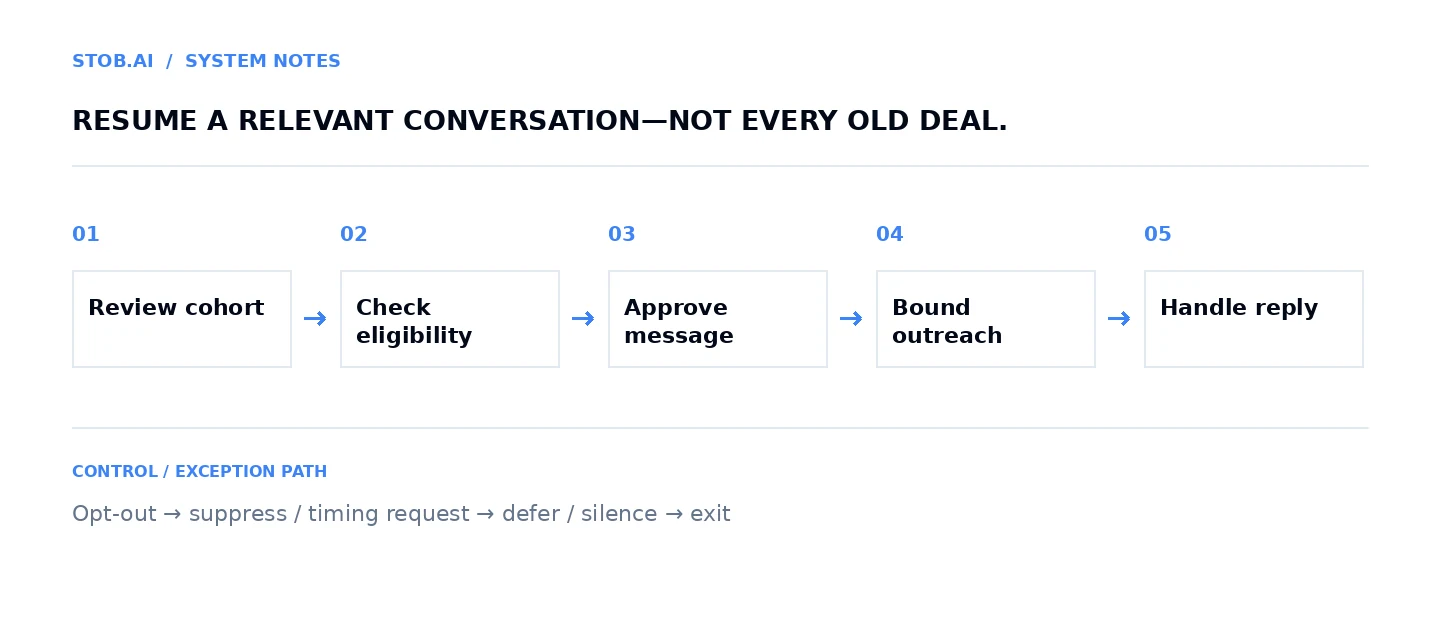
Example eligibility rules you can adapt
Illustrative starting configuration: review open deals after 30 days without meaningful buyer activity. The owner must validate the cohort before sending. Use a different threshold if your sales cycle, agreed dates or channel requirements demand it.
- The deal belongs to the intended cohort and has a valid owner.
- No meaningful buyer activity occurred inside the review window.
- No agreed future contact date, active procurement or ongoing conversation blocks reactivation.
- The contact identity and relationship are still usable.
- Current channel permission and suppression checks pass.
- No conflicting live sequence or recent touch exists at contact/account level.
- The stall reason is documented, or the case goes to internal review.
- The owner approves the message and the eligible execution window.
These are cumulative conditions, not a score where enough positive signals can outweigh a suppression. A restriction is a gate. Re-evaluate eligibility immediately before execution, even after approval.
Build a review-first state machine
Scan and segment
Make retrieves the defined CRM cohort on a schedule and deduplicates work by deal and campaign version. Separate timing, budget, fit, departed-contact and unknown cases. Recheck live ownership; do not let a historical campaign assign work away from the current owner.
Prepare a factual draft
Claude or OpenAI can summarize the prior exchange and draft a reason-specific message using permitted source context. Require evidence for any claimed change. If the record lacks a blocker or relevant trigger, ask the owner rather than filling the gap with invented personalization.
Approve and execute
The owner confirms the recipient, channel, reason and message. Bind approval to the current record and campaign version. Before sending, check suppression, timing, active conversation, previous touches and channel rules again.
For WhatsApp, outside-window follow-ups need an eligible approved template and current permission checks; a sales reactivation message is not automatically utility. See WhatsApp sales automation.
Wait, interpret and stop
A positive reply stops the sequence and creates a sales handoff with the original context. A timing reply records the agreed date. An opt-out updates suppression promptly. An objection goes to the owner; silence ends according to the approved attempt limit.
Example pilot policy: at most two approved touches over a defined period, then exit to a review state. That is an illustrative bound, not a universal recommendation. Do not automatically restart the same silent contact in the next scan.
HubSpot's enrollment guidance explains that re-enrollment and suppression require deliberate configuration. Check the actual object and workflow behavior instead of assuming the platform will prevent every repeat.
Copyable message patterns
Documented timing blocker
When we last spoke, [documented timing issue] was the reason to pause. You suggested reconnecting around [agreed period]. Is revisiting [specific objective] useful now, or should we leave this closed for the moment?
Verified relevant change
Our previous discussion paused because [documented blocker]. Since then, [verified relevant change]. Does that change the picture for [specific objective], or is the original constraint still the deciding factor?
No verified change
We discussed [documented objective] and paused at [known point]. Before I follow up further, is this still something you want to revisit? If not, I can close the loop.
Replace bracketed fields only with documented facts. Do not claim a buyer is expanding, hiring or facing urgency just because a research tool returned a vague signal. The message should be useful even without artificial scarcity.
Failure tests before any live cohort
| Case | Expected result |
|---|---|
| Another campaign contacts the account after approval | Current cross-campaign check holds the send |
| The contact opts out while queued | Suppression blocks execution |
| An automated edit updates the deal timestamp | Do not treat it as buyer activity |
| The champion left the company | Research/review; no automatic guessed replacement |
| A send succeeds but logging fails | Reconcile provider evidence before any resend |
| The buyer says “next quarter” | Record timing and stop the current sequence |
Measure recovery without overstating revenue
Define a meaningful reply and a reactivated opportunity before launch. Reopened pipeline value is not booked revenue. A CRM stage change is not proof that the buyer agreed to resume a commercial process.
- Meaningful reply rate: unique delivered contacts with a qualifying reply divided by unique delivered contacts in the cohort.
- Accepted next-step rate: contacts with a buyer-agreed, owner-accepted next step divided by eligible contacted contacts.
- Reactivation rate: opportunities meeting the written renewed-engagement definition divided by eligible opportunities assigned to the cohort.
- Safety: suppression failures and unintended repeat contacts, not just positive outcomes.
- Cost: attributable operating spend divided by verified reactivated opportunities.
Where feasible, randomly assign eligible accounts to outreach and a holdout, keeping related contacts in the same group. Compare outcomes over the same observation window. Illustrative example: 12 of 100 outreach accounts versus 7 of 100 holdout accounts meet the definition. The observed difference is five percentage points; it is not proof that every one of the 12 was caused by automation, and a small sample has uncertainty.
Report exclusions, group sizes, contact attempts and concurrent campaigns. Without a comparison group, describe observed outcomes without claiming causal lift.
A rollout checklist
- One defined cohort, a named owner and written eligibility rules.
- Separate meaningful-activity and record-update timestamps.
- Current suppression and cross-campaign controls.
- Reason-based drafts using source evidence.
- Approved attempt limits, stop rules and re-enrollment policy.
- Verified send outcomes and safe recovery after partial success.
- Accepted handoffs and consistent outcome reporting.
Start with a reviewed cohort, inspect every exception and expand only after the receiving sales process works. Reactivation should make a useful old conversation easier to resume—not make a customer defend the same “not now” repeatedly.
Frequently asked questions
What is deal reactivation automation?
It identifies eligible dormant opportunities, prepares source-grounded follow-up and routes renewed interest to a salesperson, with permission, suppression and stop rules.
How long should a deal be inactive before reactivation?
There is no universal threshold. Use your sales cycle, meaningful buyer activity and agreed contact dates. The 30-day example in this playbook is a pilot assumption.
Should every closed-lost opportunity be contacted again?
No. Segment by reason, verify relevance and current permission, exclude active conversations and suppressions, and get owner approval.
How should reactivation results be measured?
Track meaningful replies, accepted next steps and verified renewed opportunities separately from revenue. Use an eligible holdout where feasible to estimate incremental effect.
Is the reactivation playbook free to read?
Yes. The implementation fields, example rules, message patterns and test checklist are available directly in the article without an email gate.