WhatsApp Sales Automation: Consent, Templates and Human Handoff
WhatsApp sales automation connects permission-based business conversations to qualification, CRM updates, approved responses and human follow-up. It is not permission to send unlimited promotional messages or run an unrestricted AI assistant.
At Stob.AI, we would design WhatsApp around a bounded business use case: answering an inbound product question from approved knowledge, qualifying a requested enquiry or coordinating an agreed next step. Messaging eligibility, account policy and human escalation come before model selection.
Messaging policy and pricing sources were reviewed on 22 October 2026. The exact current AI-specific terms clause and territorial exceptions were not independently readable during that review; they remain unverified. Meta can change policies, categories and prices; validate the current account, recipient market, use case and provider terms before deployment. This is operational guidance, not legal advice.
Choose a narrow business outcome
“Build a WhatsApp sales bot” is too broad. Define the service: collect the requirements for a quote, answer product questions using approved source material, book an agreed consultation or route an existing customer request.
Define what the workflow cannot do. It should not invent stock, pricing, delivery dates, discounts or contractual promises. If those answers require a live system, retrieve and validate them through an approved interface. If they require a commercial decision, transfer to a person.
Use the WhatsApp Business Platform and supported provider interfaces for this design. Do not assume desktop-app scripting, unofficial bulk tools or a consumer account provides equivalent policy compliance, event handling or delivery evidence.
Permission and the service window are different checks
WhatsApp's Business Messaging Policy requires recipient permission for subsequent contact, compliance with applicable law and respect for opt-outs. Possessing a phone number, having a CRM record or having a historical deal is not sufficient permission for proactive messaging.
Record permission provenance, date, intended business context and applicable restrictions. Do not treat one historical chat as blanket permission for unrelated campaigns. Requests to stop must be respected whether they arrive on WhatsApp or another channel.
The customer-service window opens and resets when the user messages the business. Within the following 24 hours, non-template replies are permitted under the applicable rules. Outside that window, an eligible outbound message requires an approved template. The existence of a window does not make every kind of content or use case permissible.
| Situation | Decision | Required check |
|---|---|---|
| User asks a business question within the service window | Bounded non-template reply may be appropriate | Policy, current restrictions, approved knowledge and escalation |
| Business follows up outside the service window | Use an approved eligible template or hold | Permission, template category/status and current terms |
| Recipient asks to stop | Suppress conflicting outreach | Propagate the restriction across relevant workflows |
| No permission for proactive contact | Do not send the campaign | Do not manufacture consent from stored contact data |
Check the current state immediately before every send. A message drafted while the window is open may execute after it expires. An approved draft may become ineligible if the customer opts out before delivery.
Marketing and utility templates are not interchangeable
Meta's template categorization guidance distinguishes marketing from utility and authentication. Promotional, retargeting and mixed promotional-utility content should not be dressed up as a service update.
A dormant-prospect message asking whether they are ready to buy again should not automatically be categorized as utility. Utility messages relate to qualifying user actions or requests. Meta may change a template's category; store and monitor its current status rather than hard-coding the initial approval.
Approval of a template does not replace eligibility or legal review. A valid template can still be unsuitable for a recipient, account policy or intended use case.
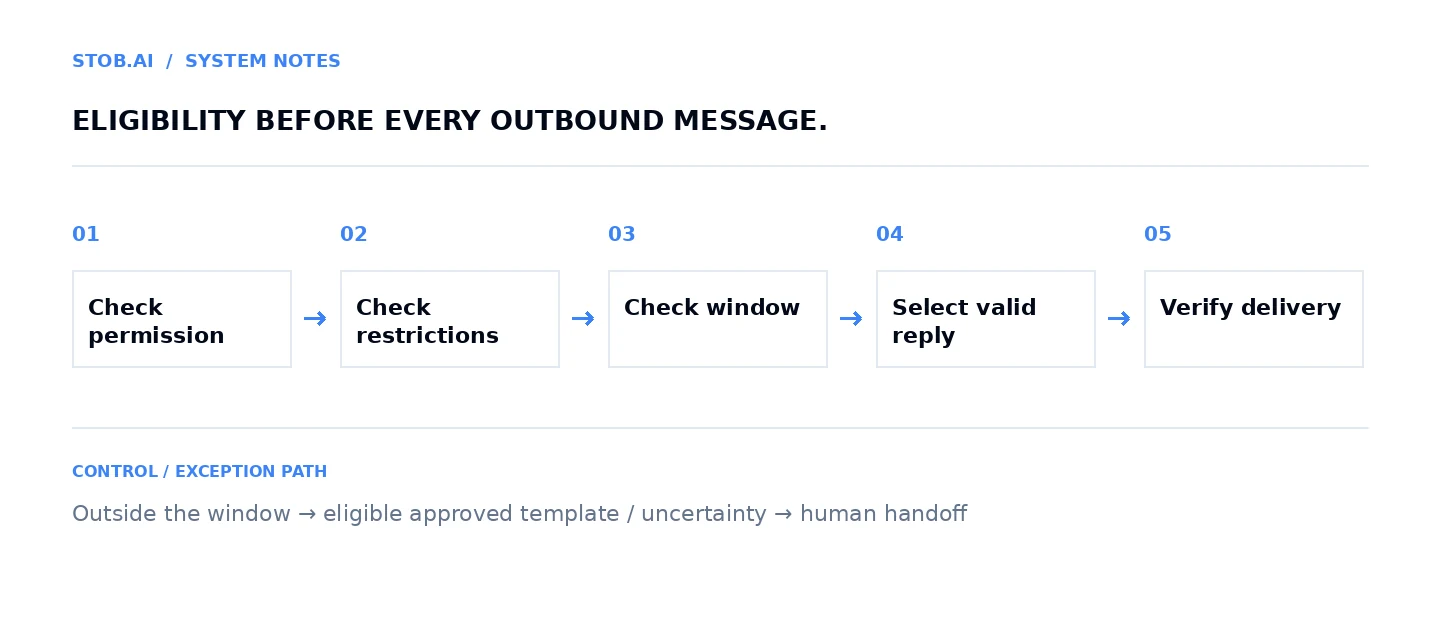
A controlled inbound sales workflow
Capture the message and current context
Authenticate the webhook, save the provider's message identifier and deduplicate repeated events. Store the time of the latest relevant user message, not the time your workflow received it. Resolve the contact through approved identifiers and preserve the original conversation.
Retrieve the existing owner, open opportunity and communication restrictions. If the number plausibly matches several people or accounts, route identity resolution to review rather than merging or overwriting records.
Classify the business request
Claude or OpenAI can propose a bounded intent such as product question, quote request, meeting request, complaint, opt-out or unknown. Retain source evidence and allow uncertainty. A customer may ask about a product while also saying they do not want promotional follow-up.
Treat incoming text as untrusted content. It cannot authorize the model to expose another customer's data, change a discount policy or call unrestricted tools. Keep tool permissions and allowed fields outside the prompt.
Retrieve, answer or transfer
Retrieve the relevant approved product or service information. Draft only what the source supports. For a request involving discounts, contractual commitments, sensitive data, complaints or uncertain facts, create a human handoff with the conversation and a clear next action.
WhatsApp's policy requires prompt, clear and direct escalation paths for automation. Provide an obvious route to a person or suitable support channel; a bot repeatedly saying “please rephrase” is not meaningful escalation.
Check eligibility again and verify delivery
Before execution, recheck restrictions, window timing and template status. If a salesperson takes over, pause automation so the customer does not receive competing answers. Execute through the permitted channel and store provider delivery evidence separately from the intention to send.
Update the CRM with a factual summary, source reference, responsible owner and next task. Use sales handoff acceptance to verify that someone has actually taken responsibility.
Do not assume a general-purpose AI assistant is allowed
Meta's Business Solution Terms and messaging policy govern the permitted use case. A bounded business-support workflow is not the same product as an open-ended general-purpose AI service.
We could not independently verify the exact current AI-specific clause, section number or territorial exceptions in the official terms. Do not treat this article as confirming permission for a particular AI deployment. Review the live terms with your platform provider before launch. Customer initiation and template approval do not independently authorize a broad general-purpose assistant.
Budget delivered-message costs, not old conversation pricing
Meta's current platform pricing uses delivered-message charges with category and recipient-market differences. Service messages and qualifying responsive utility messages can be free under the stated conditions. Do not assume all messages inside a service window are free: marketing messages and other categories have their own rules.
Check current rate cards, volume tiers and qualifying free-entry-point conditions. Add business-solution-provider fees, workflow execution, model usage, storage and human operation separately. There is no single universal WhatsApp sales-automation price.
A useful cost measure is total attributable operating cost divided by conversations that meet your qualification definition. Track delivered contacts and conversations separately; one conversation can contain several charged messages.
Test restrictions, takeover and failed delivery
- The window expires between draft approval and send: hold or use an eligible approved template.
- The customer opts out on email: prevent conflicting WhatsApp outreach under the applicable restriction.
- A template is rejected, paused or recategorized: stop affected queued sends and alert the owner.
- The model lacks a current price: transfer instead of inventing one.
- A salesperson takes over: pause automated responses for that conversation.
- The provider returns an uncertain delivery result: reconcile before resending.
Use a limited cohort and staffed review before wider automation. Test multilingual replies, ambiguous stop requests and unsupported customer requests. The correct outcome for an uncertain message may be a safe human transfer rather than an immediate answer.
Measures that matter
Track qualification outcomes, on-time human handoff, delivered-message failures, template status changes, opt-outs and the age of unresolved conversations. Define the denominator for each metric. An opt-out rate should state whether it is measured per delivered recipient or per conversation.
Do not use a generic open-rate statistic as proof of your workflow's commercial effect. Delivered messages, replies, accepted next steps, opportunities and revenue are different events.
Stob.AI's view
WhatsApp belongs in the sales system when customers want to use it and the business can operate it responsibly. We would connect it to current records, bounded knowledge, execution controls and a named human owner—not create an isolated bot that forgets the rest of the customer relationship.
Read CRM automation for record design, AI sales agents for action permissions, and deal reactivation before contacting dormant prospects.
Frequently asked questions
What is WhatsApp sales automation?
It connects eligible business conversations to bounded responses, qualification, CRM updates and human follow-up, using supported platform interfaces and current policy checks.
Can a business send any message within 24 hours?
Non-template replies may be permitted within the customer-service window, but content, use-case, restriction and policy requirements still apply. Pricing also depends on category.
Is a dormant-sales follow-up a utility message?
Not automatically. Promotional and retargeting content is generally marketing under Meta categorization; validate the actual approved template and use case.
Does WhatsApp allow every AI assistant?
Do not assume so. Review current Business Solution Terms and messaging policy for the bounded use case. Customer initiation or template approval does not independently authorize a general-purpose AI service.
How much does WhatsApp automation cost?
Cost depends on delivered-message category and recipient market, plus provider, model, orchestration, storage and human operating fees. Check current rate cards.