Automation vs SaaS: Buy the Capability or Build the Workflow?
SaaS provides software capability; automation makes work happen within and between capabilities. They are not opposites. Most useful business automations run on SaaS products, including the CRM, orchestration platform and model APIs.
At Stob.AI, we do not recommend replacing a good tool simply because a custom workflow is possible. We look for the gap: does the business lack a capability, have disconnected work between existing tools, or need to agree its process before either purchase will help?
The practical decision is whether to configure what you own, buy specialist software or build a connected workflow. The right answer depends on process fit, exceptions, urgency, operating capacity and full cost—not on a slogan about SaaS disappearing.
Diagnose the problem before comparing products
Missing capability: you have no usable CRM, accounting system or helpdesk. A mature product may solve the basic requirement faster and more safely than recreating it.
Disconnected work: suitable products exist, but people copy data, chase approvals and reconcile status. An orchestration layer may address those gaps while keeping the tools.
Undefined process: nobody agrees on qualification, ownership or accepted outputs. Software selection is premature. Automating disagreement creates a faster route to inconsistent decisions.
Map one representative transaction, including exceptions and the final accepted outcome. “We need AI” is not a purchasing requirement. “A qualified enquiry should reach an accountable owner with the source conversation and a verified next task” is.
Four options, not two
| Option | Best fit | Main responsibility |
|---|---|---|
| Configure existing SaaS | Supported local process with adequate native workflows | Configuration, adoption and access governance |
| Buy specialist SaaS | Common requirement with strong product fit | Vendor selection, migration and operating use |
| Connect existing tools | Distinctive cross-tool process and stable business rules | Integration, monitoring, exceptions and maintenance |
| Build a standalone application | Requirements unsupported by maintainable configuration or orchestration | Product engineering, security and long-term support |
Do not skip native configuration. If the CRM can implement a required assignment and task correctly, an external scenario may add dependencies without adding value. Conversely, a collection of native workflows can become difficult to govern when the same process spans several applications.
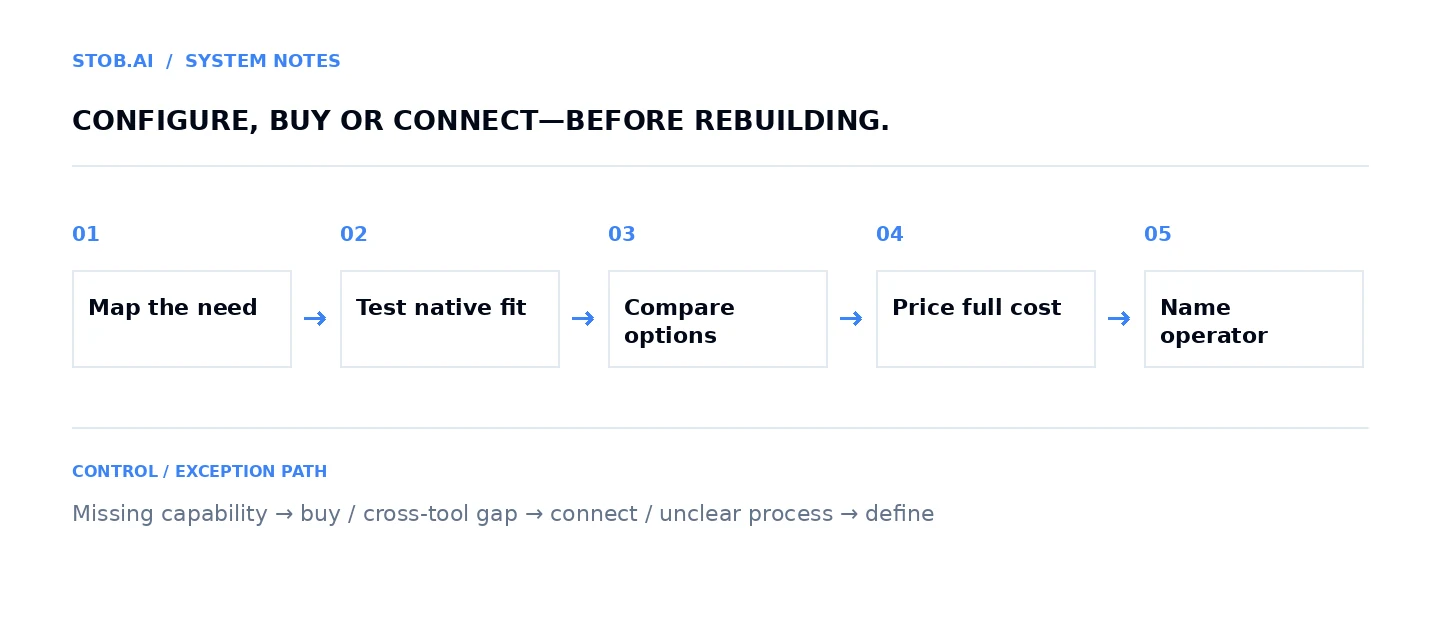
Our build, buy and connect decision framework
Use a representative trial instead of an arbitrary fit percentage. Include missing data, approval delays, duplicates, an absent owner and a failed external call. Evaluate whether the product or proposed workflow delivers the accepted result under those conditions.
| Question | Buy/configure points toward | Connect/build points toward |
|---|---|---|
| Is the requirement common? | Mature standard functionality | Materially distinctive cross-team rules |
| Where does context live? | Mostly one application | Several authoritative systems |
| Do exceptions fit? | Supported controls handle representative cases | Repeated workarounds prevent reliable completion |
| How urgent is deployment? | Immediate usable capability is critical | Time exists for discovery and controlled testing |
| Who operates it? | Limited capacity for custom maintenance | Named owner and funded operating time |
| What changes frequently? | Common changes best absorbed by the vendor | Business-specific policies need controlled modification |
| Can you recover and exit? | Product support and exports meet requirements | Documented and tested transfer justifies added complexity |
No custom production workflow should launch without an exception owner, pause procedure and fallback. Paying an implementation partner does not remove these duties; it determines who performs them and under what terms.
What a connected operating layer actually does
Consider an enquiry arriving in your existing inbox. Make captures the event, resolves the CRM identity and validates required context. Claude or OpenAI proposes an intent category or a draft. Policy checks restrict the allowed action, a human approves consequential decisions, and Make executes and verifies the result.
This is not rebuilding the inbox or CRM. It is connecting the work between them. The model handles ambiguity; deterministic logic handles permissions, exact values and controlled updates. Read CRM automation for a concrete design.
Our HoverAir case study describes message classification, approved routes, logging and escalation using connected tools. It demonstrates an operating pattern, not a universal guarantee that a custom layer outperforms every packaged product.
A transparent 36-month cost comparison
Illustrative planning example, all figures USD. These are invented assumptions, not Stob.AI or vendor quotes. Both options cover the same workflow and service hours. Existing CRM and email costs remain unchanged and are excluded from both.
| Cost | Specialist SaaS | Connected workflow |
|---|---|---|
| Implementation and training | $3,000 | $15,000 |
| Monthly product/platform/API costs | $600 | $250 |
| Monthly internal operation | 8 hours × $50 = $400 | 12 hours × $50 = $600 |
| Monthly support for assumed scope | Included | $200 |
| Exit allowance | $1,000 | $2,000 |
| 36-month total | $40,000 | $54,800 |
SaaS total: $3,000 + 36 × ($600 + $400) + $1,000. Workflow total: $15,000 + 36 × ($250 + $600 + $200) + $2,000. Under these assumptions, customization is more expensive.
If the SaaS fee becomes $1,200 per month with every other assumption unchanged, its total becomes $61,600. That sensitivity changes the result; it is not a prediction. Custom usage and maintenance can rise too.
Compare equivalent scope, coverage and quality. A retainer including campaign strategy cannot be fairly compared with a workflow that only transfers records. Report released capacity separately from cash savings unless it actually reduces spending.
Owned workflow does not mean subscription-free
You may own bespoke workflow definitions, code, prompts and documentation under your agreement. You do not thereby own Make's platform, the CRM vendor's software, OpenAI or Anthropic's models, or third-party licensed components.
Make has ongoing usage-based pricing; one business outcome can involve several processing steps. Model, data, messaging and support costs also remain. “No management retainer” and “no running costs” are different claims.
Make blueprint exports preserve scenario structure, but imported scenarios need connections recreated. Portability is a tested operating capability, not the possession of a JSON file.
Security and maintenance belong in the comparison
Packaged SaaS does not eliminate configuration and data-governance responsibility. Custom automation does not eliminate vendor dependence. For either option, inspect access, sensitive logs, retention, recovery, API changes and approval enforcement.
Model privacy claims need precision. OpenAI describes business-data training controls, while its API data documentation distinguishes retention and feature state. No-training is not no-retention.
For custom workflows, budget regression checks after schema, API or model changes. For SaaS, test migration and configuration changes. Both need a named operator who can explain what happens when a task fails halfway through.
When we would recommend SaaS
Buy or configure when the process is standard, product fit is strong, deployment speed matters, or the team cannot fund a custom operator. Established specialist software may also provide governance or domain features that would be disproportionate to recreate.
Connect tools when the bottleneck is distinctive cross-system work, the rules are clear, and the organization is prepared to run and maintain the result. Build a standalone product only when simpler options cannot meet the requirement.
The Stob.AI perspective
Our work is to diagnose the workflow and implement the appropriate system inside the existing stack—not to make every purchase a custom build. Our SaaS interface article discusses how software can become infrastructure; this guide addresses the practical buyer decision and operating economics.
Next, compare agency operation versus an owned system to decide who should run the capability, and use Sales Ops automation to specify the actual process you want to improve.
Frequently asked questions
Is automation an alternative to SaaS?
Often it is a layer on top of SaaS rather than an alternative. Native configuration, specialist software, connected workflows and standalone applications are separate options.
Is custom automation always cheaper than software subscriptions?
No. Compare implementation, platform and API usage, internal operation, support, maintenance and exit costs over the same period and scope.
What should a business buy rather than build?
Buy common capabilities with strong product fit. Build or connect where distinctive workflows and exception handling justify added operating responsibility.
Does owning an automation mean there are no monthly costs?
No. Client rights to bespoke workflows do not remove platform, model, data, messaging or operating costs, nor grant ownership of vendor software.