Best AI Business Development Agencies: Build an Outbound System Your Team Owns
Updated 6 November 2026. By Jake Hissitt, Founder of Stob.AI.
The best AI business development agencies connect better targeting to consistent sales follow-through. A serious provider should show how an account is researched, why it deserves contact, how outreach is approved and what the salesperson receives after a reply. Stob.AI builds that connected capability as a Business Development System in the client's stack.
Disclosure: Stob.AI publishes this guide and is included for its owned business-development system. The comparison distinguishes that model from outsourced SDR services rather than pretending they are interchangeable.
Business development partners by buying model
| Provider | Best fit | What you are buying | Primary diligence question |
|---|---|---|---|
| Stob.AI | Building an owned BD operating system | Connected research, execution, reply and CRM workflows | Who will own and operate each layer internally? |
| Belkins | Managed appointment setting | Campaign strategy and meeting-generation capacity | How is meeting quality accepted and rejected? |
| Martal Group | B2B technology sales outsourcing | External sales-development execution | Which segments and sales stages does the team cover? |
| SalesRoads | US-focused SDR outsourcing | Dedicated prospecting and appointment setting | How are ramp, coaching and replacement handled? |
| memoryBlue | Technology sales development | Outsourced SDR teams and talent development | What process and data transfer at the end? |

How we compared unlike services
Some providers sell meetings, some sell external sales capacity, and some build client-owned systems. We therefore did not compare raw meeting claims. We assessed fit by operating model, research quality, response handling, CRM continuity, transparency and what remains after the engagement.
Managed meetings versus an owned system
| Dimension | Managed outbound | Owned BD system |
|---|---|---|
| Time to capacity | Usually faster | Requires implementation and adoption |
| Client workload | Lower day to day | Needs an internal owner |
| Knowledge accumulation | May stay with provider | Captured in client process and data |
| Control | Defined by service agreement | Higher when accounts and logic are client-owned |
| Best fit | Immediate coverage | Strategic, compounding capability |
What a serious AI-enabled BD system contains
- An explicit ICP with exclusions and suppression rules.
- Verifiable account and contact data with provenance.
- Evidence-led research tied to a message hypothesis.
- Channel controls for timing, volume and consent.
- Reply interpretation with uncertainty and human escalation.
- CRM-ready handoff with context and next action.
- Reporting on accepted opportunities, not activity alone.
Metrics that reveal real quality
Track accepted opportunity rate, positive-intent follow-up coverage, data-error rate, time from reply to owner, pipeline by segment and the proportion of meetings rejected by sales. A high reply rate can coexist with poor targeting; a full calendar can coexist with no pipeline.
Stob.AI's published Lumens case study provides historical monthly figures of 4,000 new prospects, 16,000 emails, 120 total replies, 24 positive replies and 12 meetings across four campaigns with a four-touch sequence. These figures await confirmation against campaign records; they are not guaranteed outcomes or the allowance for our new five-campaign, 12,000-message standard implementation.
Pricing traps
Per-meeting pricing can reward volume unless acceptance criteria are precise. Retainers can hide low activity unless outputs and learning are visible. Build fees can understate data, platform and maintenance costs. Ask every provider to define a qualified meeting, replacement policy, data ownership, third-party spend and offboarding.
Questions to ask
- Show how one account moves from selection to CRM handoff.
- Who approves the positioning and message boundaries?
- How are opt-outs, existing customers and active opportunities suppressed?
- How quickly are positive replies assigned?
- What data and operating knowledge transfer to us?
Buy the operating capability, then choose how to run it
An outbound programme creates lasting value when the account research, message learning and reply context remain usable by the business. A procurement brief should therefore describe what the team will retain: configured workflows, agreed records, operating documentation and a clear way to review exceptions.
Stob.AI's Business Development System brings these elements together across signal research, outbound execution, reply handling and CRM updates. The aim is a repeatable operating process that the team can inspect and improve. Implementation and optional managed operation should have separate responsibilities so the client can understand who maintains each part after launch.
Stob.AI's published Squadzy case study reports 32 meetings in one month, using Make, Airtable, Instantly and OpenAI. Use the case to examine the connected operating approach; assess your own expected results against your market, offer and sales follow-through.
Before comparing fees, name the internal sales owner and rehearse a normal handoff. That person should be able to open the source, read the conversation, accept or reject the opportunity and assign the next action. An attractive activity dashboard is useful only when the team can turn its information into work.
For the ownership decision, read agency versus an owned system. For the operational acceptance criteria, use our sales handoff automation guide alongside the provider comparison.
Worked example: what a business development agency should deliver for one account
Illustrative example: an event production company wants to find organisers planning conferences in its service area. A useful account starts with a verifiable event announcement, including the source URL, event date, location and reason the opportunity might fit. A public announcement is a research signal; it does not establish that the organiser needs a new supplier.
The agency should then check territory, project type, timing and exclusions. Existing customers, active opportunities and previous opt-outs must be checked before outreach. Exa can support source research, while Apollo's people-enrichment documentation shows the contact-enrichment layer. Enrichment still needs validation: an identified contact may have changed role or lack buying responsibility.
Keep the evidence and approval status in an Airtable record. After an authorised reviewer accepts the account and message angle, approved outreach can run through Instantly or HeyReach within the agreed channel rules. A reply should bring its original wording back into the record, alongside a proposed classification and next action. Interest becomes a sales-accepted opportunity only when your team confirms the agreed criteria.
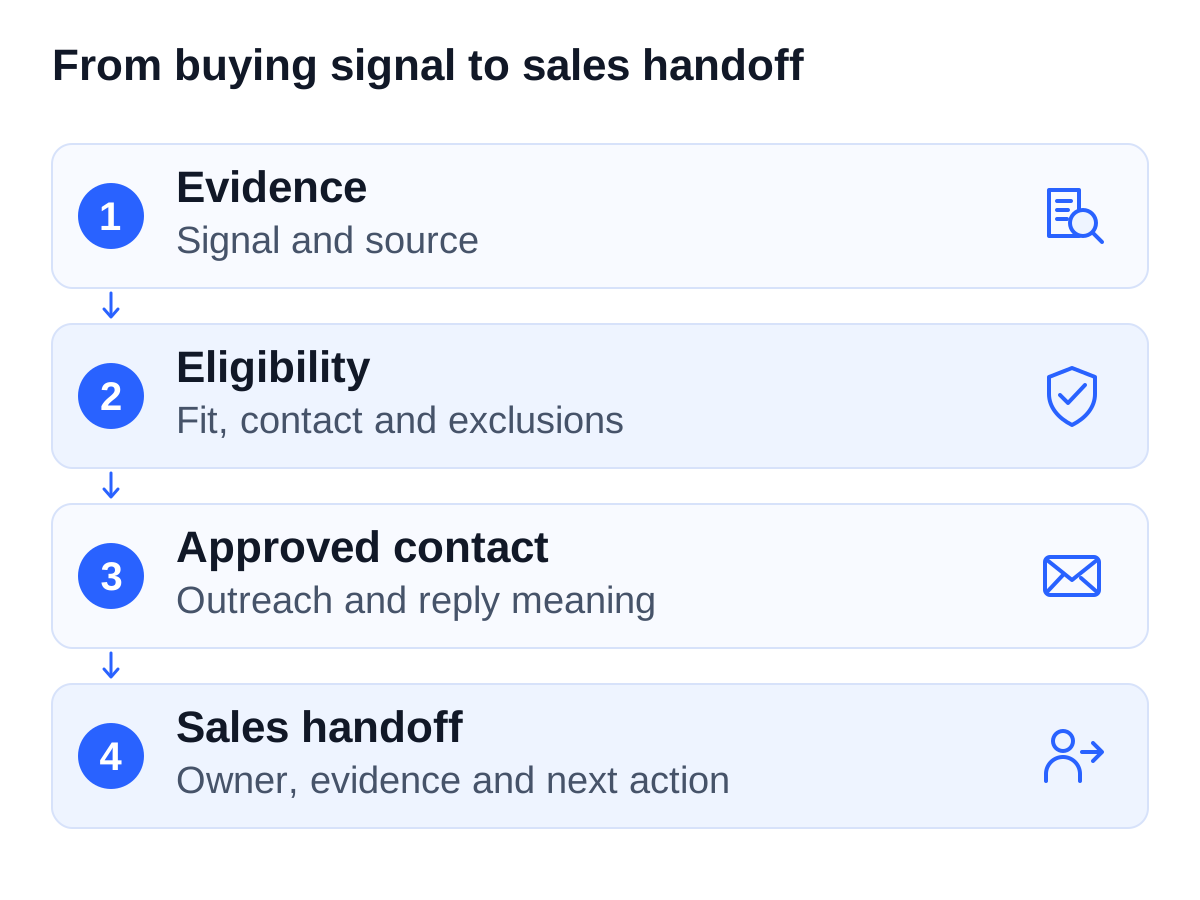
The handoff record your sales team should receive
Ask each shortlisted business development agency to show a sample record. A salesperson should be able to understand why the account matters and act without reconstructing the campaign. This is a useful acceptance test for both managed execution and an owned system.
| Record field | What a usable handoff contains |
|---|---|
| Account and contact | Company, relevant person, role, verified contact details and responsible sales owner. |
| Evidence and timing | Source link, date checked, event or buying signal, and the reason it matches your ICP. |
| Eligibility | Territory, exclusion and suppression checks, with reviewer and approval status. |
| Conversation | Messages sent, original reply, channel and timestamps, with uncertainty visible. |
| Next action | A specific follow-up task, owner, due date and relevant attachments or notes. |
| Sales decision | Accepted, rejected or needs review, with a reason that can improve future targeting. |
Reply events can connect campaign activity to follow-up. For example, Instantly's webhook documentation explains its event notifications. The buying question is whether your provider reliably turns those events into assigned work and retains the conversation context in your CRM.
A demonstration to request before choosing a BD agency
- One eligible account: trace the evidence, contact checks, approval and proposed outreach.
- One excluded account: show which rule stops it and where that decision is recorded.
- One ambiguous reply: show how uncertainty reaches a human reviewer instead of triggering an unsupported action.
- One sales rejection: show how the reason changes future account selection or qualification.
For the owned-system option, see Stob.AI's Business Development System. It connects research, approved outreach, reply handling and CRM handoff in your stack, with clear ownership and human review at the decisions that need it.
Recommendation
Choose managed execution if the immediate problem is capacity. Choose an owned system if business development is a strategic capability you want to compound. For the broader sales-leadership view, compare AI partners for B2B sales teams.