Best AI-Native Agencies: Choose the System Behind the Service
Reviewed 6 November 2026 by Jake Hissitt, Founder of Stob.AI.
The best AI-native agencies make their delivery system visible. Buyers should be able to inspect how an account, document or customer request becomes an accepted result, how experts review difficult cases and how each correction improves future delivery.
Publisher disclosure: Stob.AI publishes this comparison and appears in it. We applied the same stated criteria to every provider, linked to source material and avoided a single “best overall” verdict. Verify current scope and terms directly.
Which AI-native agency fits the job you need done?
| Provider | Best for | Public evidence considered | Watch-out |
|---|---|---|---|
| Stob.AI | Owned business development and operational systems | Named system architecture and the Lumens implementation | Specialist scope rather than a global transformation integrator |
| GrowthX | AI-native B2B growth and content operations | Published programs and operating approach | Confirm how content work connects to CRM and revenue operations |
| DEPT | Enterprise experience, marketing and technology transformation | Global service breadth and published client work | Enterprise scope may be heavier than a narrow workflow needs |
| Superside | Scaled managed creative production | Defined subscription-style creative service and AI-enabled production | Best aligned to creative operations, not broad internal automation |
| Vention | Bespoke AI product engineering | Published engineering capabilities and delivery models | Requires strong product ownership on the client side |
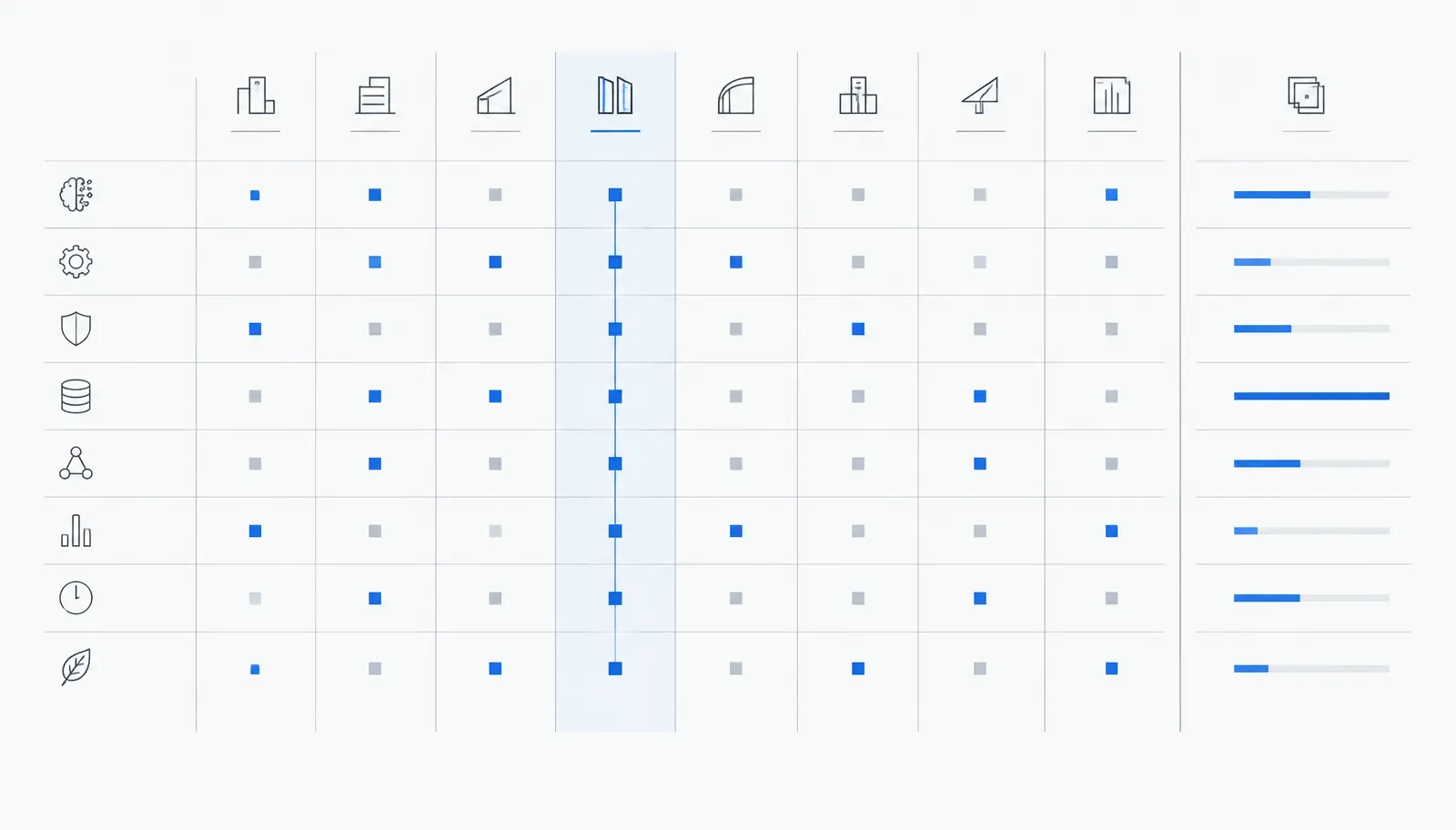
How we evaluated the agencies
We used five questions. Delivery-system evidence and proof of real work matter more than category language.
- System depth: does the offer connect data, execution, judgement, control and measurement?
- Outcome fit: is the provider demonstrably strong in the buyer's actual problem?
- Proof quality: are there named cases, inspectable methods or concrete outputs?
- Governance: are review, permissions, monitoring and failure recovery part of delivery?
- Ownership: are accounts, data, documentation and exit terms explicit?
We did not invent review scores or infer confidential client results. Public evidence varies by provider, so the shortlist is a starting point for due diligence rather than a definitive league table.
Five delivery models hidden under one label
Managed outcome
The agency operates the process and is accountable for an agreed service level. Best when capacity is the constraint and the client does not want to run the machinery.
Embedded operating team
Specialists work within the client's systems and cadence. This can accelerate adoption but needs clear boundaries and knowledge transfer.
Implementation partner
The agency builds an owned system and hands it over. Best when the workflow is strategically important and an internal owner exists.
Product engineering partner
The engagement produces bespoke software. It offers flexibility but adds product-management, maintenance and security responsibilities.
AI-enabled production service
The provider combines a service team with a technology layer for a particular function such as creative operations or research.
How to detect AI-washing during procurement
- The proposal names models but not source systems or data permissions.
- The demo follows a perfect path; no one can show an exception or failed run.
- Every decision is described as autonomous, even when deterministic rules are safer.
- Quality is measured by output volume instead of accepted business outcomes.
- Ownership of workflow accounts, logs and documentation is deferred until contracting.
Engagement models and cost drivers
AI-native agencies commonly sell a discovery phase, a fixed implementation, an ongoing managed service or an embedded team. Price depends less on the number of workflows than on ambiguity, number of source systems, security requirements, exception volume and the cost of a wrong output. Ask providers to separate build fees, platform usage, model usage, maintenance and managed-operation costs.
Questions specific to an AI-native agency
- Show us one correction that changed the delivery system.
- Which parts are reusable platform capability and which are custom to us?
- Where does human accountability sit in daily operation?
- What can our team inspect without asking your engineers?
- What continues to work if the engagement ends?
Ask an AI-native agency to show one complete revenue journey
A commercial team can use one account to test the depth of an agency's operating model. Start with the reason the account was selected. Follow the research, contact checks, approved outreach, conversation and sales handoff. Ask what the manager sees if the contact is wrong, the reply is ambiguous or a CRM update fails.
In an illustrative B2B service workflow, the research record contains a source link and a clear reason for fit. The proposed contact and message are reviewed against exclusions and the existing pipeline. After a reply, the sales owner receives the original conversation, relevant evidence and a suggested next step. The owner accepts, corrects or rejects the handoff, and that decision remains attached to the account.
Stob.AI focuses on this connected commercial layer. Its Business Development System brings research, outbound operations, reply handling and CRM continuity into one client-owned operating process. That makes it a relevant specialist to examine when a company has capable tools but loses context between marketing, prospecting and sales.
| Decision point | What the agency should show | Why it matters to the buyer |
|---|---|---|
| Account selection | Source evidence and a usable reason for inclusion | The team can challenge targeting before outreach |
| Contact and message approval | Relevant role, exclusions and an approved angle | Research becomes an appropriate commercial action |
| Reply handoff | Original wording, responsible owner and next step | Interest reaches a salesperson with usable context |
| Commercial feedback | Acceptance or rejection with a reason | The next campaign benefits from what sales learned |
Use software evidence to test the proposal
References to recognised tools are helpful when the proposal explains what each contributes. Apollo's enrichment documentation describes how contact records can be matched and enriched. Make webhooks provide an event-triggered connection between services. Airtable interfaces can present account review queues and assigned work to the people using the system.
Ask the provider to show the configured process alongside those source capabilities. Who checks an uncertain match? Where is the accepted account record? How does the rep correct an interpretation? Which changes reach the CRM, and which require review? Clear answers demonstrate delivery knowledge and give your team a practical basis for acceptance.
Choose the ownership model deliberately. A managed agency can suit a team seeking operating capacity; an implementation partner can suit a team building a strategic internal asset. When the main constraint is prospecting and sales execution, compare the business development agency shortlist. When lifecycle definitions and reporting need repair, compare AI revenue operations agencies.
Inspect delivery evidence alongside the operating model
Stob.AI's published Squadzy project records 32 meetings in one month using a connected Make, Airtable, Instantly and OpenAI workflow. Read the case studies for the project context, then ask what evidence and acceptance criteria would apply to your own sales motion. Historical campaign results are specific to the engagement and do not establish a guaranteed outcome for another business.
Recommendation
Choose the provider whose operating model matches the responsibility you want to transfer. If you want managed execution, inspect service levels and expert oversight. If you want an internal asset, inspect architecture, documentation and handover. If that distinction is unclear, start with AI-native agency vs AI automation agency.