Best AI GTM Agencies: Build Pipeline That Learns From Every Reply
Updated 6 November 2026. By Jake Hissitt, Founder of Stob.AI.
The best AI GTM agencies turn market evidence into a repeatable path to qualified demand. Look for a partner that can explain who to reach, why now, what to test and how sales feedback changes the next campaign. Stob.AI specialises in the business development system that connects those decisions to research, approved outbound and accountable follow-up.
Disclosure: Stob.AI publishes this comparison and appears where its documented business-development systems fit. Verify all provider claims and current offers directly.
Global shortlist by GTM constraint
| Provider | Best fit | Core GTM layer | Not the first choice when |
|---|---|---|---|
| GrowthX | AI-native B2B content and growth programs | Market education and content operations | The primary issue is CRM governance |
| Stob.AI | Owned business-development operating systems | Signals, research, outreach operations and handoff | You only need temporary appointment setters |
| Winning by Design | Recurring-revenue methodology | Commercial process and enablement | You need a narrow technical automation build |
| RevPartners | HubSpot-centered GTM operations | Revenue technology and lifecycle execution | You lack a viable offer or market |
| Go Nimbly | Cross-functional GTM operations | Removing revenue-team silos | You want outsourced top-of-funnel activity only |
What we looked for
GTM fit was weighted above broad AI capability. We reviewed whether the provider addresses positioning, market signals, account selection, campaign operations, response handling and the learning loop back into the offer. Public methodology and relevant cases counted more than unsourced performance claims.
The seven parts of an AI-native GTM system
- Market definition: a usable ideal-customer profile and exclusions.
- Signal capture: events that indicate timing, change or intent.
- Account intelligence: verified research assembled for a specific decision.
- Experiment design: a hypothesis, audience, message and stopping rule.
- Execution: channel-specific actions with permissions and suppression.
- Response interpretation: classifying meaning without inventing certainty.
- Revenue feedback: accepted pipeline, loss reasons and segment learning.
GTM metrics that resist vanity
| Metric | What it diagnoses | Common bad proxy |
|---|---|---|
| Time from signal to relevant action | Operational responsiveness | Number of signals purchased |
| Sales-accepted opportunity rate | Quality of targeting and qualification | Raw reply rate |
| Target-account coverage | Whether the intended market is actually reached | Total contacts added |
| Experiment learning velocity | How quickly evidence changes decisions | Campaign volume |
| Pipeline by segment | Commercial fit of the ICP | Meetings without opportunity value |
When GTM is not the first problem
If demand exists but stages, routing and forecasts are unreliable, hire RevOps first. If the market and offer are still unclear, prioritise research and positioning before automation. If strategy is sound but execution capacity is missing, a business-development service may be more direct. See AI-native GTM vs RevOps.
Commercial models
GTM partners may charge for strategy projects, program retainers, embedded teams or managed execution. Performance-linked pricing can align incentives, but only if “qualified” is jointly defined and attribution is credible. Separate media, data, platform and model costs from the agency fee.
Questions for an AI GTM agency
- Which market assumption will you test first, and why?
- How do you prevent enrichment and AI research errors reaching prospects?
- What counts as an accepted opportunity?
- How will sales feedback alter account selection and messaging?
- Which GTM assets and data remain ours?
Stob.AI's standard for a repeatable GTM handoff
A useful GTM system accumulates commercial knowledge. The account record should retain the reason it was selected, the evidence behind the message, the campaign version and the sales decision that followed. That history lets a team improve targeting when a segment produces interest but fails qualification.
In Stob.AI's approach, research, outbound and revenue follow-through share that context. AI prepares evidence and interprets responses; explicit rules control eligibility and routing. Your team approves the positioning, owns the qualification decision and can inspect where a conversation needs attention.
Ask a proposed agency to show the same account at three points: before contact, after a reply and after sales has accepted or rejected it. The evidence, owner and next action should survive each transition. This demonstration makes it easier to assess whether an engagement will produce reusable capability.
Use the business development agency comparison to assess the execution model. If the opportunity is already present and the failure sits in routing, stages or record quality, compare AI Revenue Operations agencies alongside the GTM proposal.
Worked example: test a buying signal before scaling
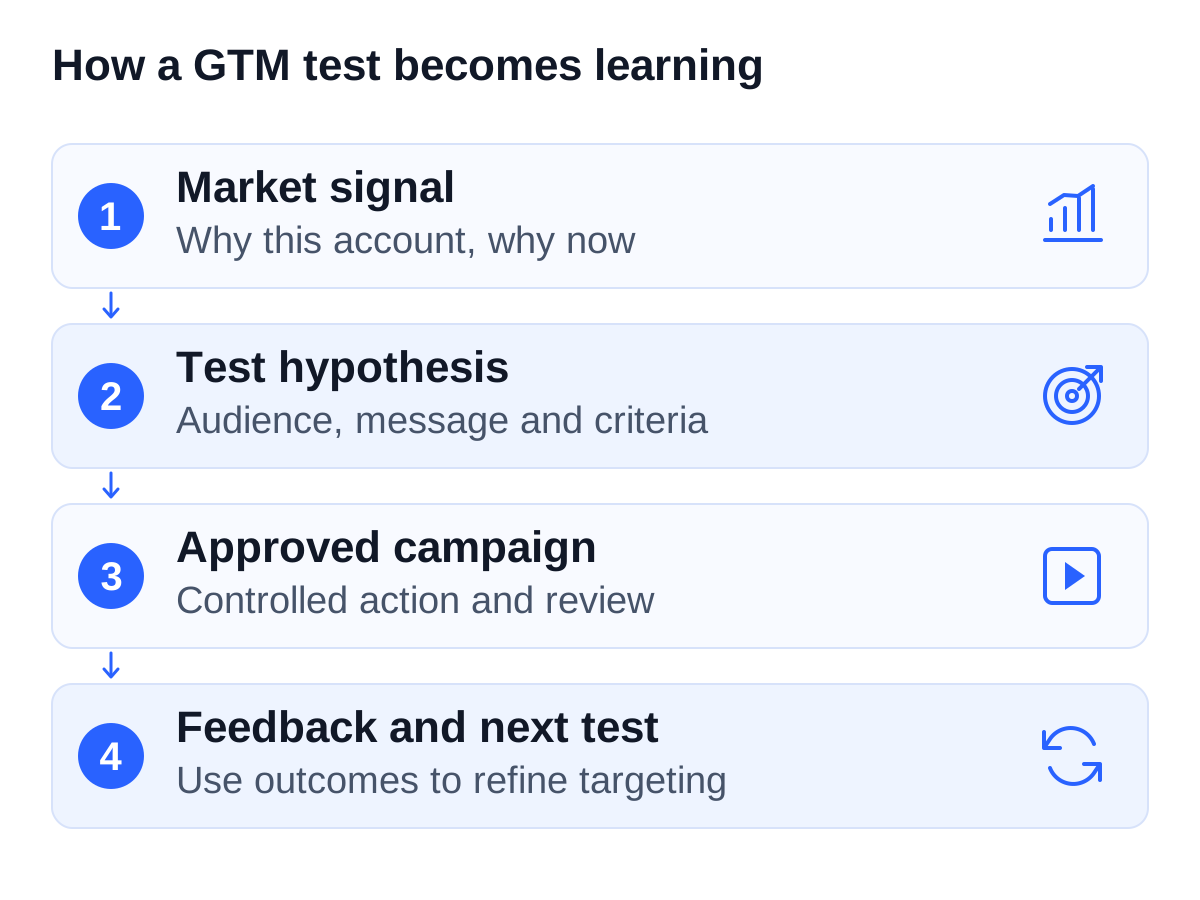
Ask an AI GTM agency to demonstrate how it would test one commercial assumption. The following is an illustrative buying scenario, with no client performance results attached: a regional event production company wants to find venues preparing to open or expand.
The starting hypothesis is specific: a planned opening may create a need for production support before the first event. The agency should retain the announcement URL, publication date, location and relevant passage, then check whether the venue fits the company's service area and capabilities. An announcement alone does not establish purchase intent.
A research service such as Exa's web search can help retrieve supporting pages and their contents. The useful output for the buyer is a short, verifiable account brief: what happened, why it may matter, what remains unknown and which role should review the opportunity.
Next, approve a small, defined cohort and one message hypothesis. For example, the outreach might ask how the venue is organising production for its opening programme, using only verified facts. The agency should agree exclusions, review dates and the conditions for pausing before execution. Existing customers, active opportunities and people who have opted out should be handled by explicit rules.
What an AI GTM agency should show after the test
The review should explain which assumption the evidence supports. Separate an interested reply from an accepted opportunity, and record why sales rejected an account. That gives the next campaign a clear adjustment to targeting, timing or positioning.
| Buying question | Evidence to inspect | Decision the buyer can make |
|---|---|---|
| Did the signal identify a relevant account? | Source link, date, service fit and exclusion checks | Keep the signal, narrow it or reject it |
| Was the message hypothesis appropriate? | Approved message, reply themes and reasons for disinterest | Change the angle or investigate the offer |
| Did interest become a usable sales handoff? | Account brief, named owner, agreed next action and sales acceptance | Fix qualification or follow-up gaps |
| Can the learning be reused? | Campaign version, segment, outcome and documented next test | Repeat a defined experiment with a clear change |
Keep the learning in your operating system
Ask where these records live and who can inspect them. Make webhooks can trigger workflows when an external service sends an event. The implementation should connect those events to the right account and campaign, apply the agreed rules and flag exceptions for review. AI can interpret reply meaning while explicit rules control eligibility, routing and status changes.
An Airtable interface can present review queues, assigned actions and campaign outcomes. Your buying brief should require access to the evidence, approval history and next-test decision, whichever software is selected.
If your main GTM constraint is connecting signals, research, outreach and sales feedback, explore Stob.AI's Business Development System. It is the relevant option here when your team wants an operating process and retained learning inside its own stack.
Recommendation
Choose on the basis of the missing GTM layer. Growth strategy, content operations, RevOps implementation and managed business development are different purchases. The best proposal should name the constraint before prescribing channels.