How to Do AI SEO: The Non-Bullsh*t Guide to AI Search Visibility (2026)
AI SEO is the practice of building search visibility into a business by solving a real problem, documenting it properly, watching for search signals in Google Search Console, then doubling down with a connected knowledge base. It is not about publishing random AI-written articles, Reddit spam, backlink begging, a paid course, or another SEO app. It is about turning search intent into demand validation — becoming the clearest answer source for the problems your market is already searching.
Want the full playbook as a downloadable resource? Get The Non-Bullsh*t Guide to AI SEO.
The Dead Internet Problem (and the Opportunity)
Dead Internet Theory says the web is slowly filling up with content that looks human, sounds human, and repeats human patterns, but is increasingly being created, copied, remixed and republished by AI.
That idea used to sound like internet folklore. Now it feels uncomfortably close to the daily experience of using the web.
Open LinkedIn and you see the same posts in different voices. Open Google and you see the same explanations with different introductions. Open a company blog and you see another generic article that could belong to any competitor. Everyone is saying roughly the same thing because AI is replicating the same inputs, the same structures and the same surface-level opinions.
This is the problem and the opportunity.
If everyone is publishing the same thing, the businesses that win are not the businesses that publish the most AI content. They are the businesses that become the clearest answer source for the problems their market is already searching.
That is what AI SEO is really about. It is not about publishing random AI-written articles. It is not about Reddit spam, backlink begging, a paid course, or another SEO app. It is about turning search intent into demand validation. It is about solving a real problem, documenting it properly, watching for search signals, then doubling down with a connected knowledge base.
Search Is Not Dead — It Has Evolved
Search was supposed to be dead. For years, people said social would replace it. Then they said AI would replace it. Then they said nobody would click websites anymore because AI Overviews, ChatGPT, Perplexity and other answer engines would do the work instead.
But search has not died. It has evolved.
People still search when they need to make a decision. They still search when a problem becomes urgent. They still search when they need a comparison, a process, a price, a risk check, a second opinion or a better explanation than the one they already have.
The difference is that search is no longer only ten blue links. Search now includes Google results, AI Overviews, ChatGPT answers, Perplexity citations, YouTube, Reddit, comparison pages, documentation, product pages, knowledge bases and snippets from trusted sources.
So the question is not whether search matters. The question is whether your business is clear enough, useful enough and structured enough to be used as a source.
The Non-Bullsh*t Guide to AI SEO
AI SEO is the operating principle behind building search visibility into a business: solve a problem, document it, watch for search signals, then double down with a connected knowledge base.
The method in one sentence: Build useful pages around questions your business is already qualified to answer, then use Google Search Console signals to expand those pages into a connected knowledge base.
This matters because AI search systems do not reward vague content for long. They need sources they can parse, summarise, compare and trust. Traditional SEO often starts with ranking pages. AI SEO starts with becoming a source that search systems can understand.
That requires clarity, structure and coverage around a problem. It also requires something most AI content does not have: proximity to the business.
Who This Is For
This is for founders and solo operators who are close to their market and want validation before spending more on product or ads.
It is for SaaS teams and B2B service businesses that know their customer problems but have not turned that knowledge into search visibility.
It is for agency owners and creators who want a repeatable content system without pretending backlinks or Reddit spam are the whole strategy.
It is for anyone who understands that go-to-market is changing. If GTM is the new MVP, AI SEO is where you can validate the idea. The market is already leaving clues in search. Your job is to turn those clues into useful infrastructure.
The Story Behind the Method
This started because I had a boring, practical problem.
I was building AI workflows and kept switching between different models: Claude, ChatGPT, Gemini and open-source models. I wanted one clean place to compare context windows, token usage, pricing, speed, reasoning ability, coding ability and which model made sense for which workflow.
There was not one place that explained it clearly enough for the way I was using the tools. So I built it. First for ChatGPT. Then model comparison pages. Then individual model pages. Then the same structure around Claude.
That is the pattern most people miss. The content did not start as an SEO trick. It started as useful documentation around a problem I already understood.
That is the foundation of AI SEO. You do not start by asking an AI model to invent a blog strategy. You start with something close to the business. A problem you solved. A decision you made. A workflow you built. A comparison you had to understand. A question a customer keeps asking. A thing you wish existed as a clear guide, table or comparison.
Then you publish the clearest useful answer you can. Then you let search behaviour show you where the demand actually is.
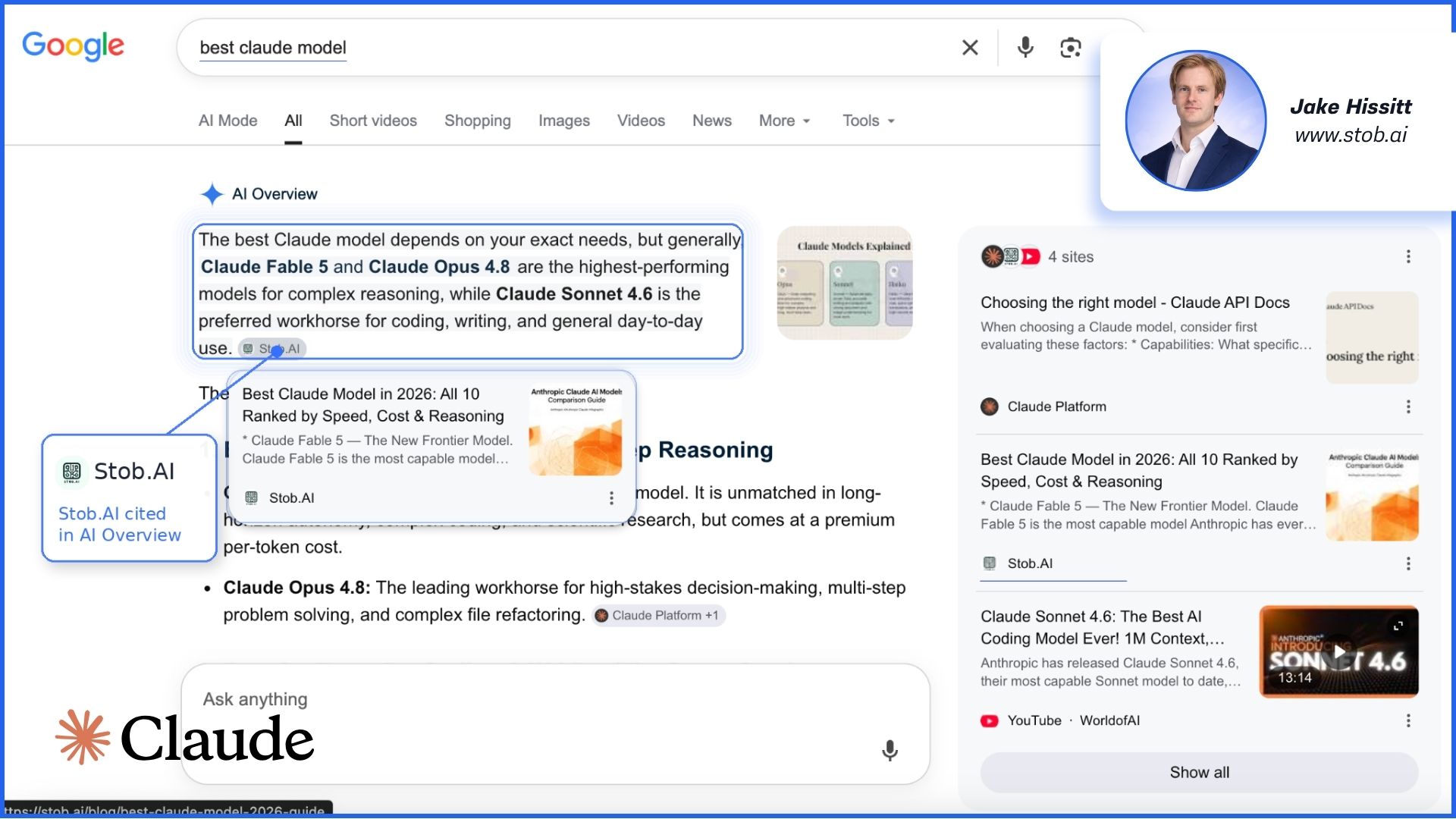
Why AI SEO Matters Now
Dead Internet Theory is useful as a hook because it describes the noise. The internet is getting flooded with average content. Average posts. Average explainers. Average listicles. Average AI-written articles that answer the question but do not help anyone make a better decision.
That creates two effects.
First, it makes generic content less valuable. If a page could sit on any competitor site, it is not a moat. If Claude could write it from a weak prompt with no business context, it is probably not enough.
Second, it makes strong source content more valuable. A page that answers one search intent clearly, includes decision criteria, uses real examples, links to related pages, and reflects actual business knowledge becomes much more useful to both readers and AI systems.
Search and AI optimization are the future because the buyer journey is becoming fragmented. A prospect might start in Google, skim an AI Overview, ask ChatGPT for alternatives, search Reddit for complaints, open a comparison page, check a pricing page, then ask Perplexity for sources. Your business does not need to control all of that. It needs to become easier to find, easier to understand and easier to cite.
That means your content has to do more than rank. It has to explain. It has to compare. It has to answer. It has to connect related ideas. It has to show why your business understands the problem better than a generic content site.
The Four-Step System
The system is simple:
- Write content close to your business.
- Look for signals in Google Search Console.
- Double down on the signals.
- Build different article varieties into a connected knowledge base.
This is not complicated. The discipline is in not skipping the obvious parts. Most people want the shortcut — the keyword list, the article generator, the backlink hack, the Reddit playbook, the prompt that writes everything. But the real leverage comes from using your own business as the source material.
Step 1: Write Content Close to Your Business
Start with the problem you are already solving, not a random keyword.
Most people make the first mistake before they write a word. They open a keyword tool and hunt for volume. That can work later, but it is not where I would start. Start with a problem inside your own business. The best early AI SEO content usually comes from something you already had to understand, fix, compare, automate, explain or decide.
What counts as close to the business?
- A problem your product, service or workflow directly solves.
- A decision your customer has to make before buying or using your product.
- A question you keep answering in sales calls, DMs, onboarding or internal work.
- A process you have done yourself.
- A thing you built internally that other people in your market probably also need.
What is too far away?
- A trend topic that gets traffic but has no clear connection to your business.
- A generic educational post that could sit on any competitor site.
- A keyword that looks attractive but would not create trust in your offer.
- A purely AI-generated explanation with no lived experience or examples.
The first exercise is simple. Write down every practical problem you have solved in the last 30 days that sits near your business.
- What did you have to compare?
- What decision did you have to make?
- What did you search for because the answer was not obvious?
- What did a customer ask you that required a proper explanation?
- What did you build internally that other people in your market probably also need?
- What did you wish existed as a clear guide, table or comparison?
That list is usually better than a keyword tool because it starts from actual business knowledge.
Document everything before asking Claude to write
Do not start by asking Claude to create an article from scratch. Start by giving it your actual raw knowledge. Give it your notes from solving the problem. Give it screenshots or tables you used to make the decision. Give it your opinion on what matters and what does not. Give it the mistakes you made while figuring it out. Give it the decision criteria you used. Give it the audience you are writing for. Give it the business context behind the page.
A weak prompt asks for an article. A strong prompt gives the business, audience, problem, raw notes, Search Console signals and desired article type.
For example:
I am building a useful AI SEO page based on a problem inside my business. The audience is [describe who this is for]. The problem is [describe the problem]. My raw notes are below. Do not invent claims. Turn them into a clear how-to guide. Structure the page with a direct answer first, then steps, examples, comparison logic, common mistakes and a practical checklist. Keep it specific to this audience.
That instruction changes the output because the thinking comes from you. Claude is organising your expertise, not replacing it.
Your first page should answer one clear decision or problem. Do not try to cover the whole category at once. A useful page usually includes:
- A direct answer in the first few lines.
- Context explaining why the question matters.
- Decision criteria such as cost, speed, risk, capability or fit.
- A comparison, table or clear sections so the answer is easy to scan.
- A recommendation for different scenarios.
- Examples from workflows, customers or operators.
- Next steps that link to related pages.
By the end of Step 1, you should have one genuinely useful page based on a problem your business understands better than a generic content writer could. (Our Best Claude Model guide and the live AI model comparison tool are examples of pages built exactly this way.)
Step 2: Look for Signals in Google Search Console
Use search behaviour to decide what to build next. Once the page is live, the job is not to sit and hope. The job is to watch for signals.
Google Search Console is enough to begin. You are looking for what Google starts testing your page against and what people are already trying to understand. Do not obsess over clicks at the beginning. Early impressions are often more useful because they show the queries Google is testing your page against.
- Look at impressions. Google has shown your page for a query, even if nobody clicked. Treat this as early demand.
- Look at low CTR. People saw your result but did not click. Improve the title, meta description, intro, angle or match to search intent.
- Look at unexpected queries. Your page is being associated with terms you did not target. That can reveal hidden opportunities.
- Look at average position. Your page may be close enough to improve. Expand the page, sharpen the answer and add relevant internal links.
- Look at page-level query spread. If one page is getting impressions from multiple related searches, turn the cluster into a knowledge base.
The collection process is simple. Open Google Search Console. Go to Performance, then Search results. Set the date range. For new pages, start with the last 7 to 28 days once data appears. Filter by the page you published. Open the Queries tab. Export the queries or take screenshots if that is easier. Look for repeated language, comparison phrases, best-for searches, use-case searches and questions.
Then give those signals to Claude:
I am using Google Search Console data to plan AI SEO content. Below are queries, impressions, clicks, CTR and average position for one page. Cluster the queries by intent. Identify the strongest content opportunities. Prioritise terms that show decision intent, comparison intent, use-case intent or direct relevance to my business. Do not chase traffic that is off-topic.
A signal is only useful if it is both searchable and relevant to your business. Score it against a simple filter:
- Is this query close to a customer problem?
- Does the query show decision intent?
- Can my business credibly answer this better than a generic site?
- Could this topic support several related pages?
- Would a visitor from this query understand my product, offer or point of view better?
By the end of Step 2, you should have a short list of search signals: queries, themes and page ideas that are close to your business and already showing demand.
Step 3: Double Down on the Signals
Write one focused article a day for the first 10 days. One useful page is the start. It is not the system.
When you see early Search Console signals, the move is to double down. Not by creating random AI content, but by building a focused set of pages around the demand Google is already showing you. In the beginning, aim for one useful article per day for 10 days around one topic cluster. This creates enough surface area for Google to understand what your site is becoming known for.
A practical 10-day AI SEO sprint might look like this:
| Day | Page type | Goal |
|---|---|---|
| 1 | Flagship decision page | Answer the main high-intent question. |
| 2 | Comparison page | Compare options people already search together. |
| 3 | Best-for-use-case page | Match one option to one workflow, role or outcome. |
| 4 | Explainer page | Define the concept that keeps appearing in queries. |
| 5 | X vs Y page | Answer a clear choice people need to make. |
| 6 | Alternatives page | Capture people looking beyond the obvious option. |
| 7 | Pricing or cost page | Explain cost, trade-offs, usage and limits. |
| 8 | How-to workflow page | Show the practical process. |
| 9 | Mistakes or troubleshooting page | Answer the problems people hit after trying. |
| 10 | Cluster review and linking page | Update the hub page and add links. |
Use the Search Console signals as the base, then expand with common search patterns: Best [thing] for [use case]; [Thing] vs [thing]; [Thing] alternatives; How to [outcome]; [Concept] explained; [Thing] pricing.
A daily sprint is useful at the beginning because speed teaches you faster. You are not trying to publish forever at that pace. You are trying to create enough content for Search Console to reveal more demand.
- Days 1 to 10: publish one focused article per day around the same cluster.
- Days 11 to 20: review impressions, queries and page performance.
- Days 21 to 30: update winning pages, add internal links and create the next 3 to 5 supporting pages.
By the end of Step 3, you should have a focused cluster of pages around one problem. This gives Google, AI systems and readers a clearer reason to associate your site with that topic.
Step 4: Build Different Article Varieties
A knowledge base needs multiple types of pages, not one repeated blog format. Different searches reveal different stages of intent. Someone searching a comparison is thinking differently from someone searching a how-to. Your content should match that.
This is where AI SEO becomes a system. You are not just writing more posts. You are building a map of the topic from multiple angles.
- Comparison pages when people are choosing between options. For example: Claude vs ChatGPT for workflow automation.
- Best-for-use-case pages when the query includes a job, role, workflow or outcome. For example: best AI model for long-context document workflows.
- Alternatives pages when people know one option but want other choices.
- Explainer pages when the market is confused by a term. For example: token usage explained for non-technical founders.
- How-to pages when people want a process they can follow. For example: how to build an AI SEO content cluster from Search Console data.
- Pricing or cost pages when cost affects the decision.
- Mistakes pages when people are trying and failing.
- Checklist pages when people need a repeatable way to decide.
- Hub pages when a cluster needs a central page. For example: AI models for workflow building, complete guide.
Do not leave pages isolated. A knowledge base works because the pages support each other. The hub page links to each supporting page. Each supporting page links back to the hub page. Comparison pages link to individual option pages. Explainer pages link to decision pages where the concept matters. Use-case pages link to how-to pages and pricing pages. Older pages get updated when you publish new supporting content.
This is also where you protect the machine. Teach the principle publicly. Keep your exact keyword map, internal linking structure, update cadence, prompts and next target pages private.
The basic page template is: Direct answer; Who this is for; Decision criteria; Comparison or steps; Recommended option; Examples; Common mistakes; Related questions; Internal links.
By the end of Step 4, you should have the start of a connected knowledge base: a hub, supporting pages and multiple article formats that answer the market from different angles.
The Tools Used
You do not need a complicated stack to start. The two core tools are enough.
Google Search Console shows what people are already searching, where Google is testing your pages and which queries deserve more content. Do not use it only as a vanity dashboard for clicks. Impressions and query spread are often more useful early on.
Claude helps turn raw notes, screenshots and query data into structure: clusters, outlines, article plans, tables and checklists. Do not outsource your thinking. Claude should organise your expertise, not replace it. (If you are unsure which model to use, see our Best Claude Model guide.)
The simple workflow is:
- Write from a real business problem.
- Publish the clearest useful answer you can.
- Use Search Console to see what queries Google tests you against.
- Give the signals to Claude and ask it to cluster by intent.
- Choose the strongest cluster.
- Publish one focused article per day for 10 days.
- Link the pages together into a knowledge base.
- Review the data weekly and improve what is already getting impressions.
That is the whole system.
Quality Checklist Before Publishing
AI SEO breaks when the page is generic, vague or disconnected from the business. Before publishing, ask:
- Does the page answer one clear search intent?
- Is the direct answer visible in the first few lines?
- Would someone in your target market care about this?
- Can your business credibly answer this better than a generic content site?
- Does the page include decision criteria?
- Does it include a comparison, table, step-by-step process or practical examples?
- Does it include your point of view or lived experience?
- Does it link to at least two related pages?
- Does it avoid fake certainty and unsupported claims?
- Would you send this page to a prospect who asked you the question directly?
After publishing, review: What language is Google associating with this page? Which terms are getting visibility even without clicks? Does the title or angle need to be sharper? Which pages are close enough to improve? What supporting pages should exist next? Are visitors from these topics moving closer to the business?
What to Avoid
- Do not publish generic AI-written articles with no business insight.
- Do not chase search volume that is disconnected from your offer.
- Do not spam Reddit or beg for backlinks as your starting strategy.
- Do not write one page and expect the entire market to understand your site.
- Do not hide the answer behind a long intro.
- Do not let Claude invent facts, claims or experience you do not have.
- Do not forget to update older pages when new signals appear.
- Do not treat AI SEO as a trick for gaming Google.
The point is to become the clearest answer source for the problems your market already has.
Common Questions
Do I need backlinks?
Backlinks can help, but this method does not start there. Start by building pages that answer real search intent clearly. If the content is useful, relevant and connected, it gives people a reason to cite or share it later.
Do I need to spam Reddit?
No. Reddit can reveal language and pain points, but using it as a fake authority tactic is not the point. Your own business problems, customer questions and Search Console signals are better foundations.
How long does this take?
It depends on your site, topic and competition. The point of the first 10 days is not instant dominance. It is to create enough relevant surface area for Search Console to show what Google is testing.
Can Claude write the articles?
Claude can help with outlines, structure, tables and rewrites. The thinking should come from you. The best pages include judgment, specific examples and clear decisions.
What if I have no Search Console data yet?
Start with the problems closest to your business. Publish one strong page, then use early impressions and query data as they appear. You can also use Google autocomplete, customer questions, sales calls and competitor gaps to create the first seed list.
Is appearing in AI Overviews guaranteed?
No. AI Overview visibility changes and is not fully controllable. The practical goal is to become a clearer answer source for search intent, which can improve your chances of being surfaced across search experiences.
Why This Can Be Automated
The process is simple enough to become a system. You can capture business problems. You can turn raw notes into structured pages. You can monitor Search Console. You can cluster queries by intent. You can build a 10-day sprint from real signals. You can create comparison pages, how-to pages, alternatives pages, pricing pages, explainers, hub pages and checklists. You can update older pages when new demand appears.
The human part is the judgment. The automated part is the workflow.
That is the useful way to think about AI SEO. Not as a content machine that sprays articles onto the internet, but as a demand validation system that turns real search behaviour into a connected knowledge base. This can be automated: www.stob.ai.
Final Thought
AI SEO is not about gaming Google. It is about becoming the clearest answer source for the problems your market already has.
Before you build more features, build the knowledge base around the questions people are already asking. Before you spend more on ads, see what the market is already trying to understand. Before you force demand, study the demand that already exists.
Pick one problem close to your business. Write the first useful page. Watch the Search Console signals. Then build the 10-day cluster.
Search is not dead. It has changed shape. The businesses that adapt will not be the ones publishing the most AI content. They will be the ones whose knowledge is easiest to find, easiest to understand, easiest to trust and easiest for search systems to use.
Get the complete playbook: Download The Non-Bullsh*t Guide to AI SEO →
Related reading: Best Claude Model in 2026 · Best AI Model 2026: Full Comparison · Live AI Model Comparison Tool · Free Resources Hub